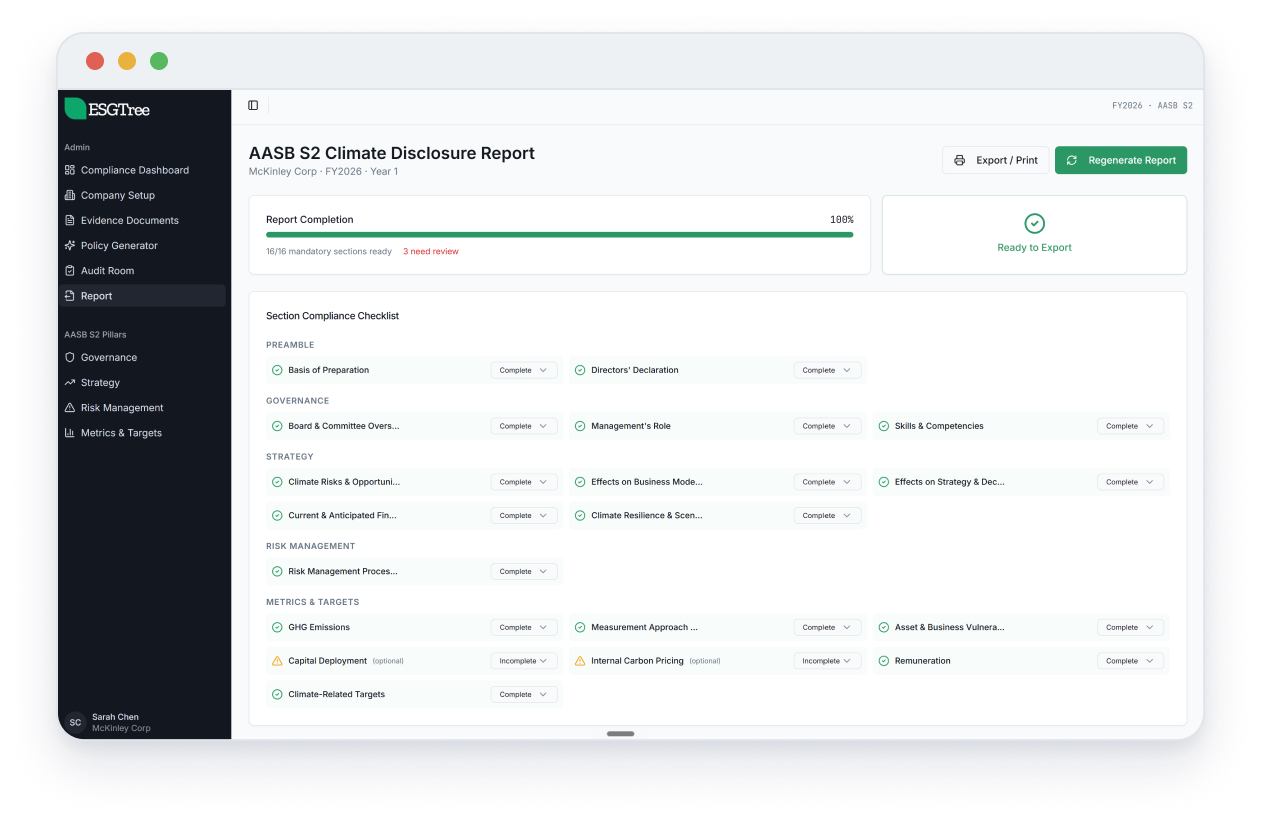
Australia’s mandatory climate disclosure regime is in force. Whether you are a Group 1 reporter in your second year, a Group 2 entity entering the regime from 1 July 2026, or a Group 3 entity preparing for 2027, ESGTree automates the data collection, emissions calculation, and audit trail that compliant AASB S2 reporting requires.
Live since 2025
From 1 July 2026
From 1 July 2027
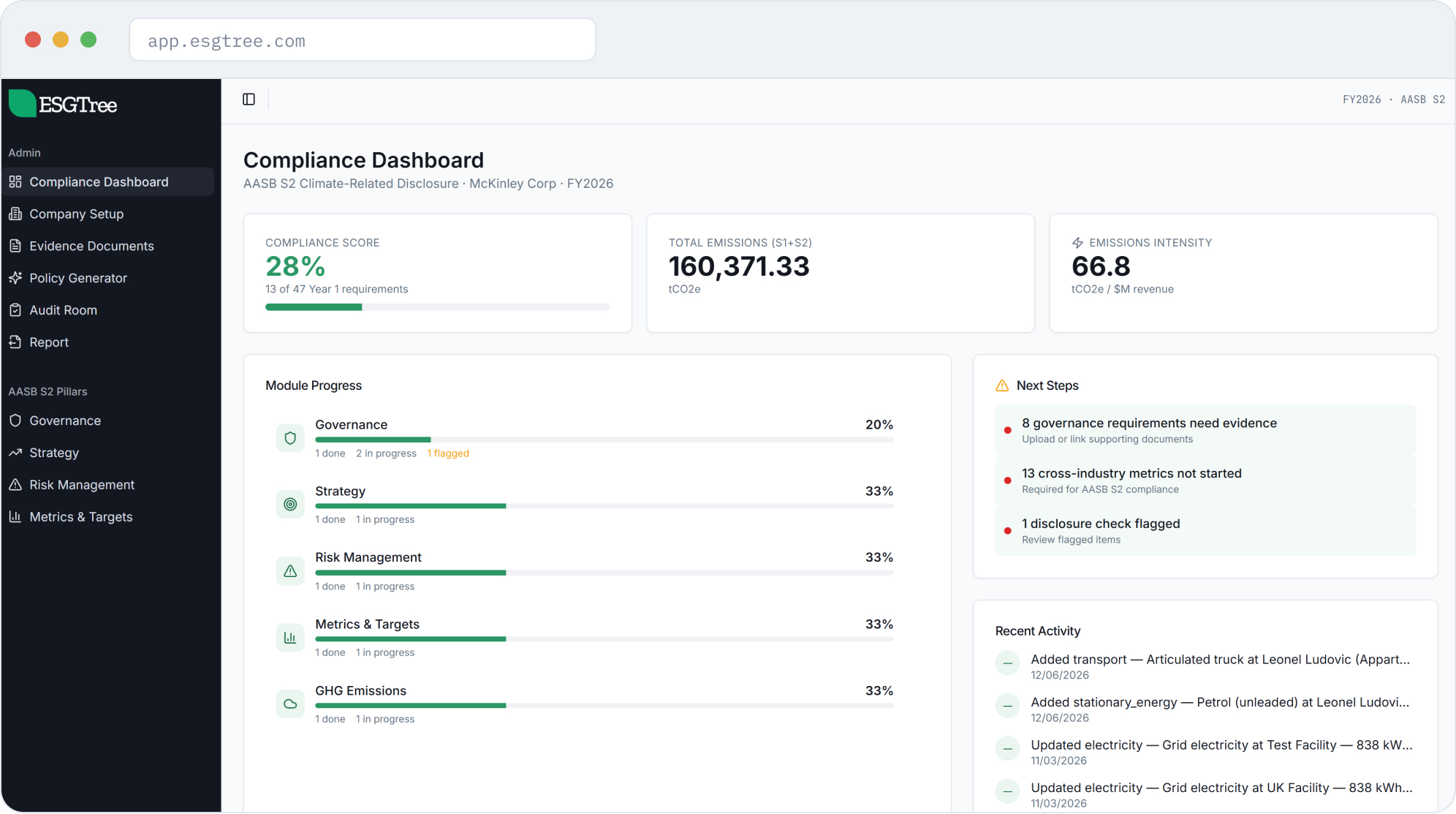
The ESGTree compliance dashboard: every AASB S2 pillar, emissions total, and outstanding requirement in one view.
Australia enacted mandatory climate-related financial disclosures through the Treasury Laws Amendment (Financial Market Infrastructure and Other Measures) Act 2024. The operative standard is AASB S2 Climate-related Disclosures, published by the Australian Accounting Standards Board in September 2024 and aligned with the ISSB’s global IFRS S2 framework. Disclosures must be included in your annual report, lodged with ASIC, and subjected to limited assurance from your first reporting year.

Board and management oversight of climate-related risks and opportunities. How responsibilities are assigned, how information flows to decision-makers, and how climate considerations are embedded in strategic oversight.

How climate-related risks and opportunities affect your business model, financial position, and prospects over the short, medium, and long term. Includes climate scenario analysis and your transition plan.

How you identify, assess, prioritise, and monitor climate-related risks, and how those processes integrate with your broader enterprise risk framework.

Your Scope 1, 2, and 3 greenhouse gas emissions, calculated in accordance with the GHG Protocol. Plus any climate-related targets and your progress against them.
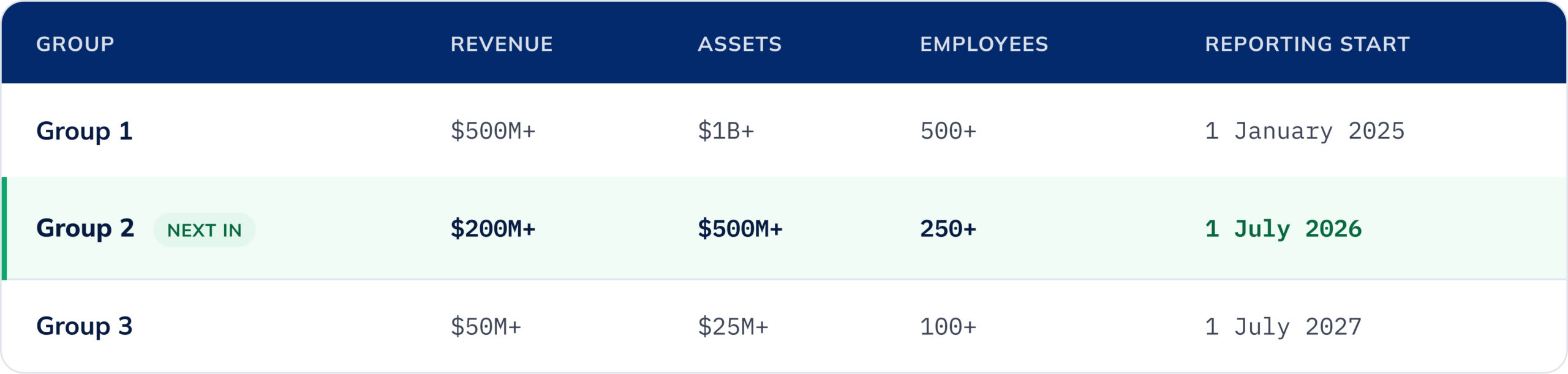
Mandatory reporting applies to entities that lodge financial statements under Chapter 2M of the Corporations Act and meet at least two of three size thresholds. The regime phases in over three years.

Superannuation funds, registered schemes, and retail CCIVs are captured under Group 2, regardless of the revenue and employee tests.

It marks when collection, calculation, and governance must be operational. The report is due to ASIC within four months of your year end.
Not sure if you are captured? Get in touch and our AASB S2 specialists will confirm your obligations.
The first mandatory AASB S2 reports were lodged from early 2026. Reviews by major advisory firms found the same gaps, again and again:

Deferrals used to fill gaps that will come due in year two.

Value chain emissions left largely unreported.

Wide gaps in rigour and depth between reporters.

Governance claims assurance teams could not verify.
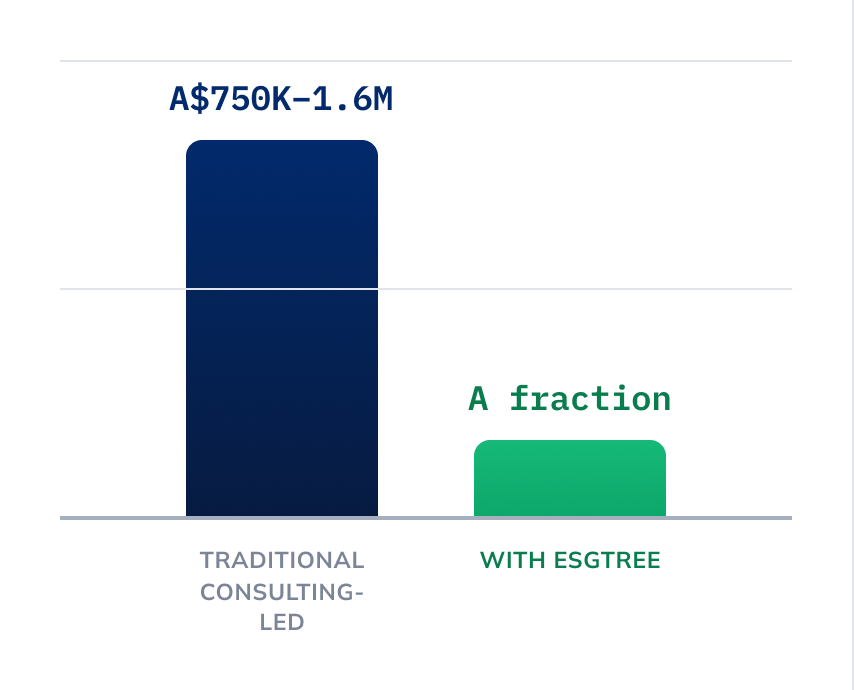
Group 1 had years of voluntary TCFD practice to draw on. Group 2 and Group 3 face the same standard with a fraction of the time, and for teams relying on spreadsheets, most of that time disappears into chasing data, reconciling versions, and re-checking calculations.
The Australian Treasury estimates AASB S2 preparation costs large organisations A$750,000 to A$1.6 million under a traditional, consulting-led approach. Those figures reflect how much of the work is done manually on billable hours.
ESGTree does that heavy lifting in software, bringing your preparation cost down to a fraction of those estimates and freeing your advisory and assurance partners to focus on the judgement-intensive work they do best.
The data and governance infrastructure for an audit-ready AASB S2 report cannot be assembled retrospectively.

Run the full AASB S2 process without hiring a large internal team. The platform structures the work and routes data requests straight to the right owners across your business.

Build your data structure once. As Scope 3 relief expires and assurance scope widens, the same foundation carries forward, with no rebuilding each reporting cycle.

NGA Factors update annually and the platform keeps pace with AASB S2 amendments and tightening assurance requirements, so your process stays compliant as the regime matures.
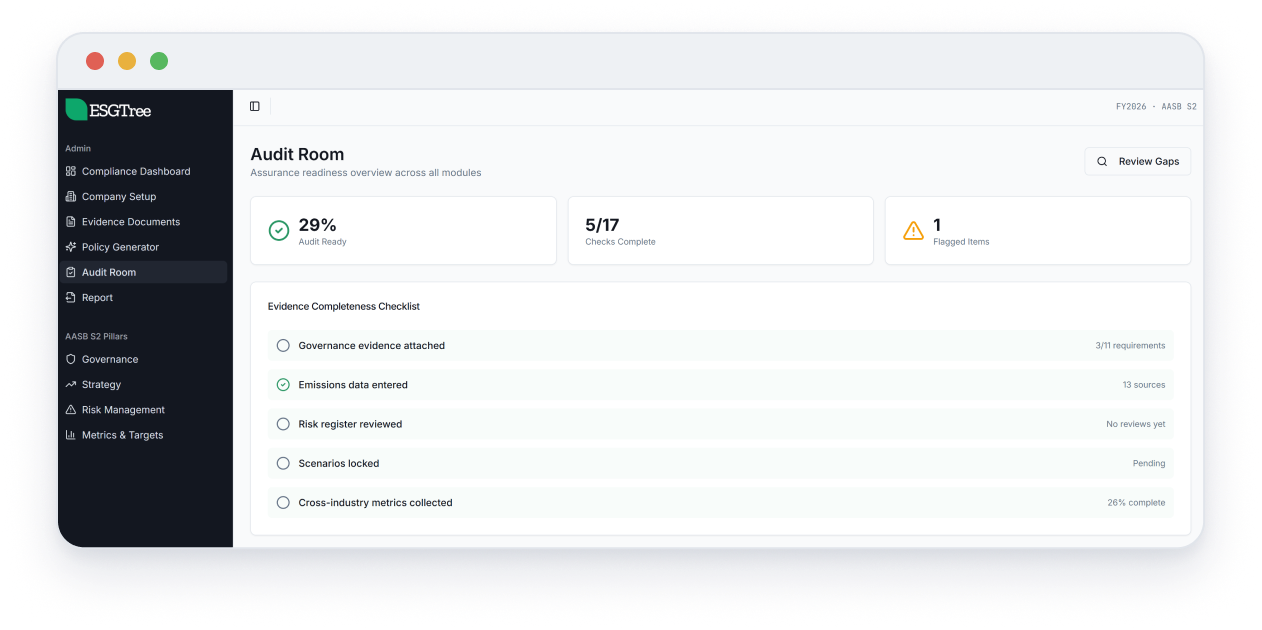
Limited assurance applies from your first reporting period. ESGTree tracks evidence completeness across every requirement, so you always know what is ready and what still needs attention, and your assurance provider works from a source-referenced, timestamped trail.
Governance, strategy, risk management, and metrics and targets are captured through structured workflows mapped directly to AASB S2. Each disclosure element links back to its underlying data, and the report assembles itself, section by section, as your evidence comes together.
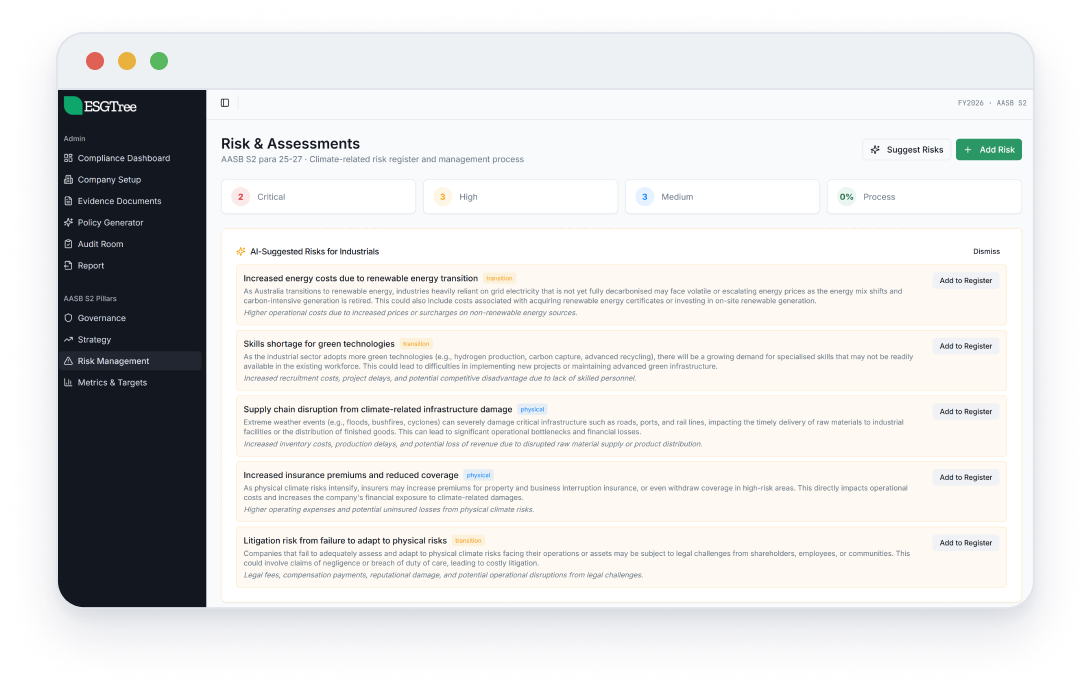
Identifying climate-related risks is where many teams stall. ESGTree suggests sector-specific physical and transition risks for your industry, which you review and add to your register, then assess, prioritise, and monitor them alongside your broader enterprise risk framework.

Scope 1 and 2 calculated with the Australian National Greenhouse Accounts (NGA) Factors, updated annually. Both location-based and market-based Scope 2 methods supported.

A dedicated module for banks, super funds, and asset managers, aligned to PCAF methodology and the AASB S2025-1 amendments for Scope 3 Category 15 disclosures.

Because AASB S2 is substantially equivalent to IFRS S2, the same underlying data supports both. Relevant for entities with parents or investors reporting under IFRS S2 abroad.

Advisory firms and assurance providers play an essential role in helping Australian entities navigate AASB S2. ESGTree is designed to support that work, not to compete with it.
Climate strategy, scenario analysis, transition planning, and materiality assessment require specialist expertise and professional judgement. Assurance over sustainability disclosures requires independence and rigour that only your team can bring. ESGTree handles the data layer: automated collection across the entity, emissions calculation, activity logging, risk register maintenance, and the traceable evidence trail that assurance requires.
For advisory firms working across multiple AASB S2 client engagements, ESGTree provides a consistent, structured data environment that reduces the time your team spends extracting, reconciling, and validating client data. For assurance teams reviewing sustainability reports, the platform’s source-referenced, timestamped audit trail simplifies the verification process.
From entities already in their second year of Group 1 reporting to Group 2 companies entering the regime in July 2026 and Group 3 entities preparing for 2027, ESGTree scales to your current stage. The platform is designed to be operable without a large internal sustainability team.
Banks, superannuation funds, fund managers, and investment platforms, including those captured under the $5 billion AUM threshold. Financed emissions calculation is supported natively. ESGTree also operates across CSRD and Canadian financial sector disclosure frameworks for institutions reporting across jurisdictions.
CFOs, company secretaries, and audit committee chairs who need assurance-ready, defensible disclosures. ESGTree provides the evidence trail that stands up to ASIC review and to your external assurance provider.
If you manage Australian portfolio companies that meet Group 2 or Group 3 thresholds, ESGTree can be deployed at the portfolio company level with consolidated reporting upstream for your fund.
ESGTree works with corporations and investors across four continents.
There is nothing to build. ESGTree is ready today. Standing up a compliant AASB S2 data collection system comes down to two things: giving the right people in each department access, and connecting to the systems where your data already lives. Once that is done, the requirement to have data collection systems in place under AASB S2 is satisfied. We move at your pace, whether you are preparing well ahead or starting against the clock.
Day one: Connect and provision. Provision platform access for each department and data owner, and connect to the systems where your data already lives. This step alone puts a compliant AASB S2 data collection system in place.
Week 1 to 2: Emissions live. Scope 1 and Scope 2 emissions inputs active, NGA Factor mapping completed, location-based and market-based methods configured.
Week 2 to 4: Disclosure workflows. Governance and strategy disclosure workflows deployed, Scope 3 scoping assessment completed, risk management integration configured.
Ongoing: Collection and drafting. Data collection running, financed emissions module live for asset owners where applicable, disclosure drafting under way.
Group 2 data collection began 1 July 2026. Past that date or ahead of it, the platform is ready now, and we will work to your timeline.
AASB S2 Climate-related Disclosures is Australia’s mandatory standard for climate-related financial disclosure, issued by the Australian Accounting Standards Board in September 2024. It requires in-scope entities to disclose climate governance, strategy, risk management, and emissions data across four structured pillars. Disclosures form part of the annual report lodged with ASIC and are subject to external assurance.
AASB S2 is Australia’s mandatory implementation, developed by the AASB and substantially equivalent to the ISSB’s global IFRS S2 standard. AASB S2 is mandatory for Corporations Act entities meeting the size thresholds. IFRS S2 is voluntary unless mandated by a specific jurisdiction. Entities reporting under both frameworks can use the same underlying data.
Reporting commences for financial years beginning on or after 1 July 2026. Data collection and governance systems must be in place at the start of that first reporting period. The first Group 2 reports are due to ASIC within four months of the relevant financial year end.
Transitional relief permits entities to defer Scope 3 emissions disclosure to their second mandatory reporting period. Scope 1, Scope 2, governance, and selected strategy disclosures are required from year one and are subject to limited assurance.
Limited assurance is a formal verification procedure performed by your external assurance provider. Under AASB S2 it applies to Scope 1 and Scope 2 emissions and selected disclosures from your first reporting year. Reasonable assurance requirements phase in for subsequent periods across all disclosure areas.
Scenario analysis assesses how your business would perform under different climate futures, typically a lower warming scenario and a higher warming scenario. AASB S2 requires entities to disclose climate resilience assessments drawing on scenario analysis. Transitional relief applies to the depth of quantitative analysis in early years, but the qualitative framework must be in place from year one.
A transition plan describes how an entity intends to adapt its business model and strategy in response to climate change. AASB S2 requires entities to disclose information about their transition planning, to the extent that a plan exists. There is no requirement to have a transition plan, but if one exists, it must be disclosed.
Yes. Asset owners with AUM of $5 billion or more are captured under Group 2 from 1 July 2026. Financed emissions calculation adds significant complexity to these disclosures and is supported natively within ESGTree’s platform.
Making false or misleading climate statements can attract penalties of up to $15 million or 10% of annual turnover. Directors carry personal liability. ASIC commenced formal review activity in 2026 and has signalled it will investigate serious or reckless misconduct without hesitation.
Yes. ESGTree provides the data infrastructure layer: collection, calculation, activity logging, risk register maintenance, and the audit trail. Your advisory firm focuses on strategy, scenario analysis, transition planning, and materiality assessment. Your assurance provider works from the evidence trail the platform maintains. The three roles are designed to complement each other, not compete.
Yes. Group 1 entities face increasing expectations in their second and third reporting years as Scope 3 transitional relief expires and reasonable assurance requirements phase in. ESGTree helps Group 1 reporters close the gaps identified in year one and build the data quality that multi-year reporting requires.
Yes. Many clients come to us mid-journey with partial data in spreadsheets or a consultant-led framework in progress. ESGTree can ingest existing data, map it to AASB S2 requirements, and take over the ongoing collection and calculation process.
Yes. ESGTree operates across AASB S2, CSRD (Europe), and Canadian financial sector disclosure requirements. For entities with parent companies or investors requiring IFRS S2 reporting, the same underlying data structure supports both without duplicate data entry.
Canada: ESGTree, CPA 4th Floor, 140 West mount Rd N, Waterloo,
ON N2L 3G6, Canada
United Kingdom: ESGTree, 33 Queen Street, London EC4R 1AP, United Kingdom