
ESGTree

Categories
ESGTREE

ESG & Impact – A Natural Fit for Credit Unions

ESG & Impact – A Natural Fit for Credit Unions

Share:

Table of Contents

When it comes to ESG & Impact Investing, credit unions are well-positioned to use both to differentiate themselves from other financial institutions. By providing innovative product opportunities for existing members and attracting new members that are seeking to integrate social considerations in investment decisions, credit unions can easily strengthen the link to their mission & spearhead the mainstreaming of Impact Investing and, to a larger extent, ESG.

An ESG Approach for Credit Unions

Today, ESG has progressed from a nice-to-have investment class “fad” to a front-page headline of a must-have sustainable investment process – one that consciously and conscientiously thinks about a company’s long-term impact on the environment & society as much as the organization’s business performance. These principles of social responsibility, financial inclusion, and community commitment are, in fact, reflected in credit unions’ missions, strategies, and product offerings, making ESG a natural and seamless fit for these cooperative, member-owned financial institutions.

An ESG approach means credit unions explicitly consider both environmental risk mitigation and ways to maximize environment/climate-related opportunities in their strategies, planning, and metrics. Unsurprisingly, the opportunities for credit unions around adopting an ESG approach are vast:

  1. Regulatory Preparedness: The U.S. may eventually follow the European Union’s lead in having additional ESG information incorporated into SEC reporting requirements. If the SEC follows through, federal and state credit union regulators will not be far behind, and it is better for credit unions to be prepared and possibly help to form any future regulations.
  2. Proactive Environmental Risk Mitigation: Credit unions are well aware of environmental and climate risks. In fact, they are often among the first responders for their members, staff, and communities when natural disasters and weather events Nevertheless, their reactive approach to environmental hurdles lacks a long-term, sustainable motive; herein lies the credit unions’ opportunity to consciously integrate ESG into their planning, operations, and strategy via a proactive approach. This could look like 1) expanding their portfolio of green lending products, 2) supporting “cleantech” through purchasing decisions and business development, and/or 3) adopting policies in lending, investing and education that support sustainability within the communities where the credit unions operate. This proactive approach would enable credit unions to mitigate the losses and the impact on their balance sheets more effectively as well as reduce the stress and injury to employees, members, and the community.
  3. Sustainable Financial Growth & ESG KPIs: Credit unions’ innate proclivity toward ESG factors offers them the opportunity to effortlessly create appropriate and quantifiable ESG-dashboard measures that can serve as meaningful Key Performance Indicators (KPIs) to senior management. Institutionalizing ESG in this way lends a more structured and defined way of driving sustainable financial growth, which is opportunely the credit union ethos. Sound performance on ESG-related measures translates into better financial returns, so a concerted consideration of ESG factors in a credit unions planning & operations will offer immeasurable success and sustainable growth for the business and stakeholders alike.
  4. An Ideological Shift in the Values of Millennials & Gen Zs: Considering how most Millennials and Gen Zers are now gravitating toward banks and credit unions that care for more than just their bottom line, credit unions that embrace existing opportunities around ESG will benefit from a burnished brand, better talent, enhanced board function, and increased ability to serve their members and stakeholders.

It is evident that credit unions are in the perfect space to adopt ESG guidelines that will accurately and transparently benchmark, measure, and evaluate their ESG performance. There are many tools and platforms out there today that consolidate these guidelines and present them in a digestible manner; ESGTree is one such platform that takes data consolidation & trends analysis to the next level by offering a one-stop-cloud-based solution that collects, analyzes, and reports ESG data seamlessly. This solution may come in handy for credit unions, who very well know that sound performance on ESG-related measures translates into better financial returns.

Impact Investing & Credit Unions

Despite credit unions’ ethos around community, sustainability, and inclusion, many treat Corporate Social Responsibility (CSR) as a tactical secondary activity; nearly 20% of credit unions provide no focus area for corporate giving and, generally, report being less than satisfied with their Impact report tracking record. If credit unions made a concerted effort to formalize the ESG opportunities outlined above and conjoined it with defined Impact Initiatives, they could become the quintessence of sustainable finance.

Specifically, credit unions have an opportunity to lead the development of the retail impact investment market in ways that other financial institutions do not. Like with ESG, the prospects here for credit unions are immeasurable:

The Supply-Demand Gap: The Rockefeller Foundation’s survey (2019) found a “significant appetite” for Impact Investing from Retail Investors. Unfortunately, the sector has been slow to respond with suitable products and for this very reason, credit unions have ample room to introduce innovative Impact Initiatives/Products that can bridge this market gap and place them at the forefront of values-based investing.

Competitive Advantage: Research conducted by the Global Alliance for Banking on Values suggests that financial institutions that base their decisions for the greater good, individuals and society, as opposed to the maximization of profits, are outperforming their competitors in areas such as return on assets, growth in loans and deposits, and capital strength. By making social finance a core part of their business model (which would include offering impact-driven products for individual members), credit unions will have an advantage over competitors.

Appeal to Millennials: As mentioned in the Section above, Millennials & Gen Zers have brought an ideological shift in the investment & consumer decision-making process. Millennials in particular are the second-most active generation engaged in impact investing and a majority of them believe that impact investing can fix a financial system that is inherently balanced or unequal, highlighting a motivation to improve the system from within. Again, this market readiness for Impact Initiatives & retail Impact products such as fixed income community notes, listed investment trusts, impact mutual funds, shows just how favorable the environment is for credit unions to take the lead.

An Immature but Rapidly Developing Market: Unlike ESG, Impact Investing is a relatively immature but rapidly developing market. Over the years, it has become much more sophisticated since funds in this asset class have started to develop more meaningful ways to measure their outcomes. In this new and immature market, credit unions can start and expand Impact Initiatives/Products at any scale. For instance, with gas prices rising and the auto market hindered by ongoing supply-chain issues, credit unions have the early opportunity to place a new focus on electric vehicles (EV). They can devise marketing to ensure consumers of modest means can afford EVs, while also opening the market for other green products, including solar panels, electric bikes, and more.


Despite the significant appetite for Impact Investing, there are daunting barriers to greater adoption. One is the lack of standardisation in measuring the ‘impact’ of investments. Investors are struggling to quantify the environmental impact of their investments – 61% of them state that this cause is difficult to measure because of the vast array of impacts and a lack of commonality. 

Currently, the 17 Sustainable Development Goals (SDGs)  are the most commonly used impact performance measurement tools, where investors assign impact to one or more of the goals, such as climate action or gender equality. This Tool has been synthesized and automatized by ESGTree, whose Platform contains an Impact Measurement feature that has improved and refined the way that capital is allocated, and returns are measured.

As solutions like ESGTree lower the obstacles to the adoption of ESG & Impact, credit unions can seamlessly use ESG & Impact to deepen financial well-being for all and advance the communities they serve – the opportunities here are endless.

Click here to learn more about ESGTree’s ESG Data Management & Reporting Software for Financial Institutions

Who Should the Economy Really Serve?

Who Should the Economy Really Serve?

The rallying cry of the American Revolution – no taxation without representation – is today taken as self-evident but deserves a re-examination in light of the climate crisis and sustainable…

Summary

Share:

How is ESG relevant to Credit Unions?

How is impact Investing relevant to Credit Unions?

How can Credit Unions integrate ESG and Impact Investing?

Contact Us

Contact Us

Email

Office Addresses

Canada: ESGTree, CPA 4th Floor, 140 West mount Rd N, Waterloo,
ON N2L 3G6, Canada

United Kingdom: ESGTree, 33 Queen Street, London EC4R 1AP, United Kingdom

Categories
ESGTREE

The Greenhouse Gas Protocol & its Scope 1, 2 & 3 Emissions Classification Explained

The Greenhouse Gas Protocol & its Scope 1, 2 & 3 Emissions Classification Explained

Share:

Table of Contents

The International Sustainability Standards Board (ISSB) announced recently that it would mandate the reporting of Scope 3 greenhouse gas (GHG) emissions – or emissions resulting from a company’s supply chain – as part of its ESG disclosure standards currently under development. Given how tricky such emissions can be to assess, the move signals the criticality of carbon footprint reporting to both investors and regulators. The ruling was unanimous. 

The ISSB is an independent, private sector body falling under the International Financial Reporting Standards (IFRS) Foundation. It was born of the much-publicized COP26 climate summit held in Glasgow last year. Its mandate is to create a unified, global set of baseline sustainability reporting standards to help investors understand the sustainability profiles of companies and their related risks and opportunities. 

The ISSB’s decision echoes other regulatory moves in 2022, such as the US Securities and Exchange Commission’s proposal to mandate climate disclosures, or the historic passing of the Inflation Reduction Act, set to spend over $70 billion on reducing carbon emissions across all sectors of the US economy. And lest we forget, national commitments to hit net zero by 2050 are only 28 years away. 

To appreciate the central role of carbon emissions reporting in sustainability and environmental regulation, we explain the meaning of Scope 1, 2 and 3 GHG emissions and their associated implications. 

What is the Greenhouse Gas Protocol?

Legal experts predict that the SEC will take until the end of 2022 to finalize and publish a rule, in some form, on mandatory climate disclosures. However, they say, this rule will almost certainly face legal challenges. In particular, experts believe the SEC will face claims that the rule is an overreach of its regulatory authority. Other contentions include the belief that mandatory reporting places an undue burden on companies and might hurt financial returns. 

The protocol provides guidelines for reporting on the emissions of the seven greenhouse gases listed under the Kyoto Protocol: carbon dioxide, methane, nitrous oxide, hydrofluorocarbons, perfluorocarbons, sulphur hexafluoride and nitrogen trifluoride. Of these, carbon dioxide is by far the most emitted greenhouse gas as a result of human activity. 

What are scope 1, 2 and 3 carbon emissions?

The GHG Protocol classifies the reporting of emissions into three main categories:

Scope 1 (direct emissions): GHG emissions produced by operations that are directly controlled or owned by the reporting company. 

Scope 1 emissions are further divided into four classes:

  • stationary combustion: emissions resulting from the combustion of fossil fuels e.g., boilers for heating
  • mobile combustion: emissions resulting from burning fuel for company owned or used vehicles 
  • fugitive emissions: accidental emission leaks e.g., gas leaks from refrigerators or air conditioners
  • process emissions: emissions resulting from industrial and on-site manufacturing processes

Scope 2 (indirect emissions): GHG emissions produced indirectly from the reporting company’s outside purchase of necessities such as electricity, heating or cooling. 

Scope 3 (indirect emissions outside company purview): Indirect GHG emissions resulting from the supply chain of the reporting company. 

Scope 3 emissions are difficult to assess because they do not fall under company control. So much so that the ISSB will provide what it calls “relief provisions” to help businesses comply with its frameworks’ mandated Scope 3 reporting requirement. 

Scope 3 emissions are divided into no less than 15 categories and include emissions resulting from business travel, employee commuting, wastewater treatment, landfill waste, transportation and distribution of goods, and investments (see below), among other considerations. 

What are financed emissions?

In addition to Scope 1, 2, and 3 emissions, investors should be aware of their financed emissions. Financed emissions are those emissions generated by the loans and investments of any financial institution such as a bank or investment firm. Accounting for financed emissions allows organizations to better asses sustainability-related risks and opportunities associated with their investments. 

To do this, the Partnership for Carbon Accounting Financials (PCAF) was launched in 2019. Conceived by financial institutions, this industry-led framework condenses and standardizes the collection, assessment and reporting of financed emissions. 

ESGTree’s automation of the PCAF framework simplifies this process by allowing companies to input basic activity related information to calculate their carbon emissions across all scopes while providing investors with figures and analytics for financed emissions of their portfolio. ESGTree is currently working with Canadian banks to automate their PCAF data collection, analysis, and reporting.

ESGTree helps private capital investors automate ESG data collection and analysis for their portfolio companies. Our platform features include our carbon calculator, customizable and automated ESG frameworks, multi-level report viewing, trends analysis dashboard, and other features aimed to make ESG work for everyone.

Click here to learn more about ESGTree’s ESG Data Management & Reporting Software for Financial Institutions

Who Should the Economy Really Serve?

Who Should the Economy Really Serve?

The rallying cry of the American Revolution – no taxation without representation – is today taken as self-evident but deserves a re-examination in light of the climate crisis and sustainable…

Summary

Share:

What is ISSB?

What is the Greenhouse Gas Protocol?

What are Scope 1, 2 and 3 emissions?

What are financed emissions?

How can Banks leverage ESGTree to automate their PCAF commitments?

Categories
ESGTREE

TCFD Reporting: Software Solutions for Financial Institutions

TCFD Reporting: Software Solutions for Financial Institutions

Share:

TCFD_Reporting_Saas_FInancial_Institutions

A Global Shift Towards TCFD

In 2017, the Task Force on Climate-related Financial Disclosures (TCFD) introduced a framework to help organizations report their climate-related financial information and assess climate risks and opportunities.    

Today, the TCFD is one of the most commonly used disclosure frameworks across the globe, with countries such as the UK and New Zealand among the first to require TCFD-aligned climate reporting. In fact, the TCFD is now set to move into the administration of the International Sustainability Standards Board (ISSB), a merger that is expected to bring further cohesion among the plethora of sustainability standards and frameworks available for asset managers. Thankfully in the past six years, financial institutions have recognized that climate risks are intertwined with financial risks, motivating them to drive emissions down. 

The Four Pillars of the TCFD

The framework itself consists of 11 disclosure recommendations spanning four interrelated thematic areas: governance, strategy, risk management, and metrics and targets. Apart from the last area, these recommendations are largely qualitative in nature and can be summarized as follows:  

  • Governance: companies should disclose their management and board’s strategy for monitoring and assessing climate risk (and opportunity).  
  • Strategy:  companies should identify climate risks and opportunities foreseen over the short, medium and long term; explain the impact of these risks and opportunities on their planning and operations; and assess how resilient their strategy is in various climate-related scenarios (i.e., climate stress tests).  
  • Risk Management:  companies should explain their process for identifying and managing climate risk and how this process fits into the overall picture of risk management.  
  • Metrics and Targets: companies should disclose the specific metrics used to inform their climate strategies, including the disclosure of scope 1, 2, and 3 greenhouse gas (GHG) emissions among other conventional metrics. They should also disclose climate goals or targets and their progress towards them. 

TCFD Reporting Made Easier with Software Solutions

Reporting GHG Emissions: A Novel Requirement 

Measuring and disclosing financed emissions (i.e., GHG emissions associated with loans and investments) as part of climate disclosures is a new deliverable for many organizations/ financial institutions and, as such, will require new routines, organizational structures, and processes for gathering data.  

All this takes time and resources – the learning curve is steep and for some companies these changes need to be implemented in time for the 2024 reporting year. A lot of the times, organizations estimate their climate figures by buying data from providers such as MSCI, S&P, & Sustainalytics to fulfil their climate disclosure requirements – unfortunately, financial institutions cannot do this for their private markets portfolios. This is primarily because their investing and lending data needs to be collected first-hand from the portfolio, which can only be done with the help of customized tools, automations, and individuals with industry expertise. For these reasons, financial institutions, on the private markets side, end up seeking the expertise of external consultants and Software solutions that can ease the reporting burden by seamlessly collecting climate data that tracks the full extent of their carbon footprint. 

Partnering with a SaaS platform on ESG automation can help:

Streamline collection of large sets of climate data  
Calculate emissions with easily available activity data 
Generate automated TCFD Assessments  

A Deep Dive into ESGTree’s TCFD Reporting Software for Private Equity

ESGTree is purpose-built for financial institutions and private equity firms. We offer a full suite of features for your TCFD reporting needs: 

ESGTree’s TCFD Tool Features 

Description 

Automatic TCFD report generation 

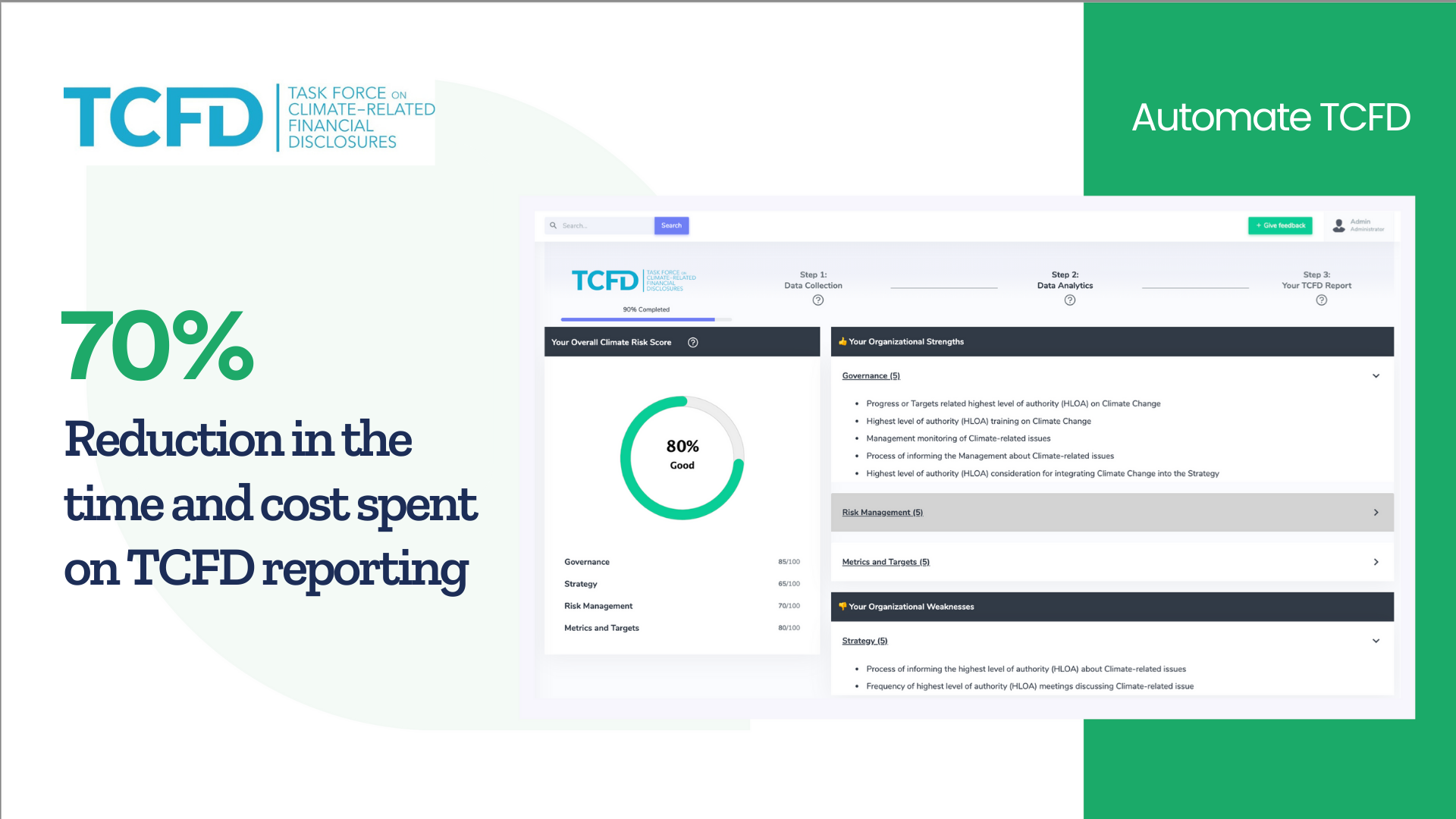
Upon completing 40 multiple-choice questions, our platform automatically generates your TCFD report – automate the difficult legwork and eliminate the need for external consultants. 

Climate Strategy Expertise 

We leverage advanced analytics and automate major ESG and climate disclosure frameworks to deliver timely, independent, and decision-useful insights.  

Quality & Clear Climate Maturity Assessment 

We assess an organization’s climate maturity, considering both the clarity (breadth of coverage) and quality (depth of actions) of its climate performance against TCFD recommendations. Our platform provides recommendations and action items to improve climate performance vis-a-vis the four pillars of the TCFD framework.  

Data-Driven Market Intelligence 

Benchmark your climate progress against a data set of 10,000+ companies. 

Proprietary Carbon Calculator & Portfolio Company Scorecards 

Our Carbon Calculator allows for seamless calculation of carbon emissions by taking in data that companies readily have on hand to provide figures for Scope1, 2, and 3 emissionson the spot.    

Trends, Analysis and Visualizations  

We offer trends analysis and visualizations by ESG framework, indicator and reporting period. 

Add-on Advisory Services for ESG policy creation, strategy road-mapping, training, and reporting 

Our Client Success Team is comprised of experts in Climate, ESG and impact investing who advise our clients on strategy and provide support on every step of the ESG journey.  

Free client success support from ESGTree experts 

A Deep Dive into ESGTree’s TCFD Reporting Solution for Private Equity ​

Given the international buy-in and legislative action around TCFD, we strongly advise adding the TCFD framework to your climate action plan. By acting now, you can stay ahead of the regulatory curve and minimize transition risk as the world moves towards a lower carbon economy.  

With ESGTree, save the time and cost of ESG reporting by harnessing the power of the cloud and streamlining ESG data collection, analysis and disclosure.  

For more information on the TCFD Reporting Solution, please contact us at :

[email protected]

 or 

Click here to book a demo.

ESGTree helps private capital investors automate ESG data collection and analysis for their portfolio companies. Our platform features include our carbon calculator, customizable and automated ESG frameworks, multi-level report viewing, trends analysis dashboard, and other features aimed to make ESG work for everyone.

Click here to learn more about ESGTree’s ESG Data Management & Reporting Software for Financial Institutions

#ESGTree #TCFDReporting #SustainableFinance #ClimateResilience #FinancialInstitutions #PrivateEquity #VentureCapital

Who Should the Economy Really Serve?

Who Should the Economy Really Serve?

The rallying cry of the American Revolution – no taxation without representation – is today taken as self-evident but deserves a re-examination in light of the climate crisis and sustainable…

Summary

Share:

A Global Shift Towards TCFD ​

The Four Pillars of the TCFD

TCFD Reporting Made Easier with SaaS Solutions

Automate TCFD with ESGTree's TCFD Software

A Deep Dive into ESGTree’s TCFD Reporting Solution for Private Equity

Contact Us

Contact Us

Email

Office Addresses

Canada: ESGTree, CPA 4th Floor, 140 West mount Rd N, Waterloo,
ON N2L 3G6, Canada

United Kingdom: ESGTree, 33 Queen Street, London EC4R 1AP, United Kingdom

Categories
ESGTREE

Canada Federal Budget 2023: Clean Energy Highlights

Canada Federal Budget 2023: Clean Energy Highlights

Share:

Canada’s release of its 2023 federal Budget: A Made-In-Canada Plan, comes at a pivotal moment in global commitments to a clean energy transition. From President Biden’s historic signing of the Inflation Reduction Act south of the border (85% of which focuses on climate), to robust sustainable finance and greenwashing-busting legislation in Europe, Canada too includes various investments in and tax credits for clean technology in its new budget.

The federal budget targets three priority areas: healthcare, affordability for everyday citizens, and the clean economy transition. It proposes $43 billion in net new spending over the course of six years, slightly raising the country’s debt-to-GDP ratio for the next two. Current federal debt is at $1.18 trillion.

Budget 2023: Clean Economy

The 2023 budget provisions for a clean economy cover the following areas:

  • Clean energy and electrification (e.g., support for innovating the electricity grid)
  • Clean manufacturing
  • Greenhouse gas emissions reduction
  • Electric vehicles and batteries
  • Infrastructure
  • Critical minerals
  • Support for other major projects

A combination of financing, tax credits, pollution pricing and regulatory frameworks, and targeted funds aims to tackle these areas. In particular, it will provide:

  •   $20.9 billion in tax credits over six years, including:

o   The Clean Electricity Tax Credit ($6.3 billion over four years)

o   The Clean Hydrogen Investment Tax Credit ($5.6 billion over five years)

o   The Clean Technology Manufacturing Tax Credit (about $4.5 billion over five year)

o   An expansion of the Carbon Capture, Utilization, and Storage Investment Tax Credit (expect to cost $520 million over five years)

  •   At least a $20 billion investment in clean power and clean infrastructure by the Canada Infrastructure Bank
  •   $30 billion over 13 years to Natural Resources Canada to fund smart grid and smart renewables programs
  •   $1.5 billion to the Critical Minerals Infrastructure Fund towards energy and transportation projects to unlock priority mineral deposits
  •   $500 million over 10 years to the Strategic Innovation Fund to support the development of clean technologies
  •   Reduced corporate tax rates for companies manufacturing zero-emissions technology

Canadian and US clean economies

Over USD$100 trillion of private capital is expected to be invested towards building clean economies between now and 2050, according to the Canadian government. “Canada is currently competing with the United States, the European Union and countries around the world for our share of this investment,” it said.

Moreover, with the Inflation Reduction Act, the “sheer scale of US incentives will undermine Canada’s ability to attract the investments needed to establish Canada as a leader in the growing and highly competitive global clean economy. If Canada does not keep pace, we will be left behind,” the government continued.

That said, given how the economies of the two countries are inextricably linked, Canada also stands to benefit from the legislation, especially its energy and mining sectors. For example, US investment in clean manufacturing technology will require a steady supply chain of critical minerals, which Canada possesses.

The clean energy transition and ESG

Critical to the transition to a clean economy is regulatory oversight over funds and investments claiming to be “green,” reducing greenhouse gas emissions, and allowing investors to compare the sustainability risk profile of companies. To start, Canada has mandated that all Crown corporations disclose their climate data in line with the Task Force on Climate-Related Financial Disclosures (TCFD) framework starting in 2024. Moreover, the US Securities and Exchange Commission (SEC) is on the brink of releasing a rule similarly mandating US public companies to disclose their climate data in-line with TCFD recommendations. Given the global buy-in, both in North America and Europe, of regulated climate disclosures, ESG reporting will continue to grow as an integral oversight tool of a greener economy – in public and private markets alike. 

Integrating ESG into financial institutions

In order to implement some of the budget’s key provisions, the Budget Implementation Act (Bill-C47) is currently being debated in Parliament. Its provisions include enhanced corporate governance oversight and DEI disclosures for Federally Regulated Financial Institutions (FRFI). In addition to targeting financial crimes, the proposal would also require some measure of public disclosure on the representation of women and minorities among senior management positions. 

While these provisions target FRFIs, ESGTree advises that other financial players, including private equity and venture capital firms, stay ahead of the regulatory curve by embedding ESG principles into their operations as well as into all stages of the investment lifecycle. Moreover, given the budget’s strong focus on reducing greenhouse gas emissions and moving towards a more sustainable economy, financial institutions would do well to consider not only their emissions but those resulting from the supply chain, prioritizing those suppliers with strong ESG credentials. One reporting tool is The Partnership for Carbon Accounting Financials (PCAF),  a global partnership of financial institutions that aims to standardize the data collection, assessment and reporting of greenhouse gas emissions associated with their loans and investments i.e., their financed emissions. The PCAF standard is ideal to implement because it comes from within the industry itself.

Canada’s budget illustrates that, in addition to the importance of centering sustainable economic policies, the green transition will be a highly competitive process, opening avenues of significant investment. In this new environment, the organizations that thrive will treat ESG as a critical pillar of value creation. 

About ESGTree

ESGTree’s platform not only collects and analyzes ESG data in the cloud, but also automates ESG frameworks like PCAF, generating reports, recommendations, and portfolio benchmarking against a dataset of 10,000+ companies. Moreover, tools like our Carbon Calculator allow companies to both calculate and monitor their greenhouse gas emissions with information readily available on hand, cutting out the need for consultants. 

ESGTree helps private capital investors stay ahead of regulation and easily collect, analyze and report their ESG data by harnessing the power of the cloud.

Click here to learn more about ESGTree’s data management and reporting software for private capital investors. 

Who Should the Economy Really Serve?

Who Should the Economy Really Serve?

The rallying cry of the American Revolution – no taxation without representation – is today taken as self-evident but deserves a re-examination in light of the climate crisis and sustainable…

Summary

Share:

What are the clean economy provisions of the federal Budget 2023: A Made-In-Canada Plan?

How does the Inflation Reduction Act affect Canada’s clean economy transition?

How can Canada benefit from the Inflation Reduction Act?

Where does ESG fit into the clean energy transition?

Contact Us

Contact Us

Email

Office Addresses

Canada: ESGTree, CPA 4th Floor, 140 West mount Rd N, Waterloo,
ON N2L 3G6, Canada

United Kingdom: ESGTree, 33 Queen Street, London EC4R 1AP, United Kingdom

Categories
ESGTREE

The Inflation Reduction Act of 2022:  A Summary of its Climate and Energy-Related Provisions

The Inflation Reduction Act of 2022: A Summary of its Climate and Energy-Related Provisions

Share:

Signing the 730-page Inflation Reduction Act into law last month was by no means inevitable. 

The bill passed muster in the United States Senate only by the slimmest of margins, itself a pared down version of what was originally envisioned as a $2 trillion dollar climate spending law. Nevertheless, the US climate bill, as it is colloquially known (about 85% of it focuses on climate), has been heralded as a genuine gamechanger, described as both “sweeping” and “historic” in most media commentary. 

In a nutshell, the Inflation Reduction Act is a $737 billion law focusing on healthcare, taxes and the environment. It aims to lower drug prices for American consumers, increase corporate tax, and provide $369 billion in spending on clean energy, environmental justice initiatives, and cutting greenhouse gas emissions – potentially by 40% below 2005 levels by decade’s end, according to some estimates

The bill has also faced some criticism from environmental groups over certain concessions to the fossil fuel industry. It links renewable energy and fossil fuels together by prohibiting the leasing of land for wind and solar projects without first leasing land for oil and gas ones. It also guarantees drilling opportunities in Alaska and the Gulf of Mexico (the Biden administration had previously curtailed offshore drilling). 

To understand the scope of this massive bill, a summary of key climate and clean energy-related clauses pertaining to industry and economy is provided below. * 

Reducing Carbon Emissions

The bill focuses on reducing carbon output across all sectors of the American economy by providing:

  • $30 billion in grants and loans for states and utilities companies to accelerate their transition to clean energy
  • $27 billion towards accelerating the deployment of clean technologies
  • $9 billion for federal procurement of domestically produced clean technologies  
  • $6 billion towards reducing emissions in the industrial manufacturing sector 
  • Tax credits for the usage of clean energy sources and their storage, for clean fuels and clean commercial vehicles, and for reduction of emissions from industrial manufacturing
  • A Methane Reduction Programme to reduce leaks from natural gas production and distribution

The protocol provides guidelines for reporting on the emissions of the seven greenhouse gases listed under the Kyoto Protocol: carbon dioxide, methane, nitrous oxide, hydrofluorocarbons, perfluorocarbons, sulphur hexafluoride and nitrogen trifluoride. Of these, carbon dioxide is by far the most emitted greenhouse gas as a result of human activity. 

Clean Energy Transition

The bill devotes $60 billion to support domestic renewable energy manufacture across the supply chain. Provisions include:

  • $30 billion in tax credits to support the manufacture of solar panels, wind turbines, batteries, and the processing of minerals critical for such purposes
  • $20 billion in loans to build country-wide clean vehicle manufacturing facilities
  • $10 billion in investment tax credit to build clean energy manufacturing facilities (e.g., factories making electric vehicles or solar panels)
  • $2 billion in grants to retool auto manufacturing facilities to equip them to build clean vehicles 
  • $2 billion towards national energy research
  • $500 million towards the Defense Production Act for heat pumps and processing of critical minerals 

Environmental Justice and Supporting Rural Communities

The bill will spend $60 billion on initiatives supporting those disproportionately affected by climate change. Key initiatives include:

  • $3 billion in grants to community-led projects addressing climate-change related public health issues (e.g., communities disproportionately affected by pollution)
  • $3 billion towards reducing air pollution at ports by procuring zero-emissions technology
  • $3billion to support neighbourhood safety, equity and accessibility programs
  • $1 billion to buy clean heavy-duty vehicles such as school buses and garbage trucks

In addition to the $60 billion, further funding is allocated towards developing clean energy in rural communities and protecting the natural environment. This includes:

  • $20 billion (roughly) to bolster sustainable agricultural practices
  • $5 billion for forest conservation efforts
  • $4 billion to combat drought in the nation’s west
  • $2.6 billion for coastal habitat restoration efforts
  • Grants and tax credits to support the production of biofuels

To do this, the Partnership for Carbon Accounting Financials (PCAF) was launched in 2019. Conceived by financial institutions, this industry-led framework condenses and standardizes the collection, assessment and reporting of financed emissions. 

ESGTree’s automation of the PCAF framework simplifies this process by allowing companies to input basic activity related information to calculate their carbon emissions across all scopes while providing investors with figures and analytics for financed emissions of their portfolio. ESGTree is currently working with Canadian banks to automate their PCAF data collection, analysis, and reporting.

Fossil Fuels

The Inflation Reduction Act also contains provisions on the fossil fuel industry that both support and constrain it. These include:

  • Federal lands and offshore waters cannot be leased for renewable energy projects without also providing space for fossil fuel projects
  • Funding is provided to the industry to monitor air pollution 
  • Incentives are provided to install carbon capture and efficiency-related solutions
  • Fees are imposed for natural gas extraction and methane leaks

Who might benefit the most from the Inflation Reduction Act?

Industries that look to benefit from the climate bill include renewable energy, electric vehicles, and mineral/lithium extraction (e.g., for batteries). 

Canada’s energy and mining sectors also look to benefit. Canada may also be incentivized to play “climate catch up” with the US, which formerly seemed to lag behind on global efforts to combat climate change and bolster greener economies. 

The Climate Bill and ESG Reporting

Given the millions of dollars of investment into the green energy transition, one wonders what mechanisms for accountability could be put in place for companies involved in this transition. One answer might be the US Securities and Exchange Commission (SEC) proposal to mandate climate reporting for public companies, aligned with Taskforce on Climate-related Financial Disclosures (TCFD) recommendations. 

An aspect of both the climate bill, as well as TCFD reporting, is attention to greenhouse gas emissions. This means both investors and organizations must be able to collect and analyze hard data around emissions and other metrics and targets – and strategize around it. Tools that streamline and simplify this process, such as ESGTree Carbon Calculator, will become increasingly necessary as ESG regulation continues to solidify around the world.  

While the Inflation Reduction Act is indeed a huge victory in the effort to ‘green’ the American economy, it does not exist in a vacuum. While not an ESG bill per se, it certainly compliments global efforts to enhance and standardize ESG compliance. 

ESGTree provides powerful data solutions to help private equity (PE) and venture capital (VC) firms gather, collect, analyze, benchmark and report their ESG data and that of their portfolio companies. Our carbon calculator, customizable and automated ESG frameworks, multi-level report viewing, trends analysis dashboard, and other features aim to make ESG a value creation tool rather than a reporting burden. 

Click here to learn more about ESGTree’s ESG Data Management & Reporting Software for Financial Institutions

Summary

Share:

What is ISSB?

What is the Greenhouse Gas Protocol?

What are Scope 1, 2 and 3 emissions?

What are financed emissions?

How can Banks leverage ESGTree to automate their PCAF commitments?

Categories
ESGTREE

A Brief Overview of the US SEC’s Proposal to Mandate Climate Disclosures

A Brief Overview of the US SEC's Proposal
to Mandate Climate Disclosures

Share:

In March 2022, the United States Securities and Exchange Commission (SEC) proposed that all publicly listed US companies be mandated to report their climate data in alignment with Taskforce on Climate-related Financial Disclosures (TCFD) recommendations. 

When the proposal was then opened for public comment and feedback, the SEC received over 3,400 letters – significantly more than it customarily does when seeking public input. Responses came from small businesses, large corporations, trade organizations, investors, auditors, academics and individual citizens. The proposal has received both endorsement and criticism from business leaders, government representatives and the media.

What timeline can we expect on the implementation of this proposal?

Legal experts predict that the SEC will take until the end of 2022 to finalize and publish a rule, in some form, on mandatory climate disclosures. However, they say, this rule will almost certainly face legal challenges. In particular, experts believe the SEC will face claims that the rule is an overreach of its regulatory authority. Other contentions include the belief that mandatory reporting places an undue burden on companies and might hurt financial returns. 

How do US companies currently disclose climate data?

So far, companies rely on guidance based on a 1976 Supreme Court decision. This guidance focuses on materiality i.e., those considerations likely to affect financial performance and are key to a business’s goals, decision-making and impact. It also grants much discretion to companies on how to undertake this reporting. 

Reporting data in-line with TCFD would be quite a departure from solely materiality-focused reporting. In addition to reporting scope 1, 2 and 3 emissions, companies would also have to report the potential impact of climate risk on their business, strategy and future health.

The four pillars of TCFD

TCFD recommendations are largely qualitative in nature and can be summarized as follows: 

Governance: Companies should disclose their management and board’s strategy for monitoring and assessing climate risk (and opportunity). 

Strategy: Companies should identify climate risks and opportunities foreseen over the short, medium and long term; explain the impact of these risks and opportunities on their planning and operations; and assess how resilient their strategy is in various climate-related scenarios (i.e., climate stress tests). 

Risk Management: Companies should explain their process for identifying and managing climate risk and how this process fits into the overall picture of risk management. 

Metrics and Targets: Companies should disclose the specific metrics used to inform their climate strategies, including the disclosure of scope 1, 2, and 3 greenhouse gas emissions among other conventional metrics. They should also disclose climate goals or targets and their progress towards reaching them. 

Support and backlash to the proposal

Prominent business leaders supporting the SEC’s proposal include BlackRock CEO Larry Fink and Brookfield Asset Management’s Mark Carney. Moreover, the proposal has come in the middle of a global push for ESG regulation (shortly preceding the historic passing of the Inflation Reduction Act). 

On the other hand, ESG in general has gotten caught up in America’s culture wars. This proposal has been viewed in some quarters as part of a greater push for liberal agendas. Certain Republican state governors (e.g., those of Florida, Texas and West Virginia) believe the SEC is overstepping its legal role of regulating the trade, marketing and issuance of securities (which includes for private markets) for the protection of investors. 

Florida, in particular, has banned taking ESG considerations into account when making investments on behalf of its state pension plan.

Relief to investors

The World Economic Forum has predicted that half of the top 10 risks over the next decade are related to climate. This proposal, if enacted, would be hugely beneficial to investors who can then compare the risk profiles of potential investments in a transparent and standardized manner. 

What would the SEC proposal mean for businesses?

Businesses would require greater internal or even external resources to implement TCFD, considering the potential exposure to legal risk and investor confusion should reporting not be undertaken carefully and thoroughly. 

That said, climate and ESG reporting can – and should – be approached as a value creation exercise rather than a reporting burden. To simplify the TCFD reporting process, ESGTree’s cloud-based platform boils down the reporting process to 40 simple multiple choice questions that, upon completion, automatically generate the TCFD report, thereby automating much of the difficult legwork. Based on the responses to the questions, ESGTree is able to provide recommendations and action items on how to improve a company’s climate performance vis-a-vis the four pillars of the framework. ESGTree’s complementary Carbon Calculator allows for the seamless calculation of carbon emissions by taking in data that companies easily have on hand and providing figures for their Scope 1, 2 and 3 emissions instantaneously. 

The global regulatory context and the way forward

The SEC proposal doesn’t exist in a vacuum. Other TCFD-aligned laws or proposals include:

  • Mandatory TCFD-aligned reporting in the United Kingdom for 2022 onwards
  • Mandatory TCFD-aligned reporting for Crown corporations in Canada from 2024 onwards
  • Japan, New Zealand, Brazil, Singapore and Switzerland aim to have some kind of TCFD-aligned reporting by various timelines

Given international support for TCFD, it is advisable to add this reporting to climate action plans now rather than later to anticipate future regulatory changes and reduce transition risk as the world moves towards a greener economy. 

ESGTree helps private capital investors automate ESG data collection and analysis for their portfolio companies. Our platform features include our carbon calculator, customizable and automated ESG frameworks, multi-level report viewing, trends analysis dashboard, and other features aimed to make ESG work for everyone.

Click here to learn more about ESGTree’s ESG Data Management & Reporting Software for Financial Institutions

Summary

Share:

What can we expect from the SEC’s proposal?

Who supports and opposes this proposal?

How do US companies currently disclose climate data?

What are the four pillars of TCFD?

Categories
ESGTREE

Diversity Equity & Inclusion: Preparing Private Equity for DEI Reporting

Diversity Equity & Inclusion: Preparing Private Equity for DEI Reporting

Share:

Diversity,Equity & Inclusion Reporting software tool

When the Institutional Limited Partners Association (ILPA) updated its diversity and inclusion guidelines for GPs last year, it signalled to the private equity industry that the ‘S’ of ESG would now be of increasing scrutiny and importance to investors. 

ILPA expanded its Due Diligence Questionnaire (DDQ) and Diversity Metrics Template to provide for more robust reporting on Diversity, Equity and Inclusion (DEI) and a strengthening of reporting mechanisms. In the words of ILPA CEO Steve Nelson, “While DEI is a comparatively newer area of focus for Limited Partners (LPs), the industry is experiencing a sea change in LPs’ appetite for more nuanced information about team diversity and General Partner (GP) actions to advance DEI.”

ILPA expanded its Due Diligence Questionnaire (DDQ) and Diversity Metrics template to provide for more robust reporting on Diversity, Equity and Inclusion (DEI) and a strengthening of reporting mechanisms. In the words of ILPA CEO Steve Nelson, “While DEI is a comparatively newer area of focus for LPs, the industry is experiencing a sea change in LPs’ appetite for more nuanced information about team diversity and GP actions to advance DEI.”

DEI Reporting: What the Market Has Shown Us:

  • Tracking diversity, equity, and inclusion (DEI) has gained traction among private equity (PE) firms and LPs. This development is part of a larger societal trend. In recent years, global social movements centered on DEI have sparked reexamination in every part of society, including business. In fact, research shows that DEI is good for business, regardless of geography.


  • In the private markets industry, LPs are placing increasing importance on PE firms’ diversity metrics in making allocation decisions. In response, the PE industry is making steady progress on improving the diversity of its workforce. In fact, research by the Institutional Allocators for Diversity, Equity and Inclusion (a consortium of asset owners looking to drive DEI in the asset management industry) found that DEI in private equity (PE) can potentially improve performance and reduce risk across portfolios. 
  • Other studies also bode well for DEI and PE. The International Finance Corporation (IFC), for example, found that “venture capital-backed companies in emerging markets with gender-balanced leadership teams had a 1.6 times increase in their step-up valuation, or change in valuation between rounds of financing.”


  • Our own experience corroborates this trend. When automating ESG frameworks, such as the ESG Data Convergence Initiative, we have had to provide additional reporting add-ons on DEI to satisfy our clients’ investor demand for this information.

DEI Reporting: Where to Start?

Before embedding strong ‘S’ policies into an organization, two things are paramount: asking the right questions and collecting the right data.  As a baseline, one may ask: How can my business maximize the quality of life for its people (i.e., its employees, management, suppliers and community), particularly for marginalized groups (such as women or minorities)? How will my DEI efforts minimize risk and safeguard my reputation as an equitable organization?

Benchmarking and DEI Reporting - Giving Data Meaning

  • At the 2022 Invest Canada conference in Ottawa this May, ESGTree was posed a pertinent question on benchmarking and DEI: should DEI policies account for region? In other words, how should DEI efforts in a homogenous region differ from those in a diverse metropolitan area? Indeed, questions of benchmarking – in other words, of contextualizing information – give meaning to raw data in ways that account for ground realities and therefore impact strategy and performance. 

  • Asking the right questions will help organizations move beyond token DEI initiatives that serve only to tick off the boxes investors ask for. Embedding genuine DEI policies into a business – beyond boosting company morale, culture and output – minimizes reputational risk. A workplace that embraces and celebrates a diverse community of stakeholders, while emphasizing mutual respect, is less likely to have to battle harassment, racial or other scandals later down the line, or spend precious time putting out fires while trying to do business. In the super-information age, the court of public opinion is the only one that matters. And it moves fast.

DEI Reporting and the Power of Automation

  • With so much at stake, from investor appetite to reputation management to hiring and retaining the right talent, a majority of organizations are still struggling to effectively manage and analyze their ‘S’ data.


  • 55% of companies surveyed by Ernst and Young reported that they still used excel spreadsheets to manage their ESG data. The 72 respondents surveyed included some of the largest corporations in the United States. At the same time, respondents acknowledged how serious ESG reporting is becoming and anticipated devoting much more time to it.


  • This gap between action and intention is easier to understand when accounting for the current difficulties that companies face when collecting and analyzing ESG data. The ESG industry, though exponentially expanding, is still in the midst of regulating and standardizing metrics and reporting mechanisms. ESG managers (a job that in itself is only now rapidly growing) are faced with various reporting frameworks and different requirements for different investors, with little guidance on how to implement them. Hiring external consultants to handle this data is both expensive and time-consuming.  In such an environment, GPs can stay ahead of the curve, and save themselves much hassle and headache, by automating their data and using cloud-based systems to collect, analyze and report it.


  • In fact, ILPA’s third Diversity in Action (DIA) roundtable in August 2024 revealed that, while firms can take a variety of approaches to collecting and aggregating ESG and DEI data, many firms that lack the resources to build robust internal data collection platforms are frequently leveraging service providers and consultants to aid in the process. 

The road toward equity in PE is long, but sustained efforts on actions that can fast-track progress will help the industry realize its goals. LPs can further strengthen the industry’s dedication to DEI and, by turning these commitments into action, PE firms can sharpen the competitive advantage that diversity offers.

Difficulties in ESG data reporting

 This gap between action and intention is easier to understand when accounting for the current difficulties that companies face when collecting and analyzing ESG data. The ESG industry, though exponentially expanding, is still in the midst of regulating and standardizing metrics and reporting mechanisms. ESG managers (a job that in itself is only now rapidly growing) are faced with various reporting frameworks and different requirements for different investors, with little guidance on how to implement them. Hiring external consultants to handle this data is both expensive and time-consuming.  

ESGTree highly recommends that organizations harness the power of the cloud and data automation to keep on top of investor demand, prepare for future regulatory requirements, minimize reputational risk, and gain the most from inclusive policies. 

Who Should the Economy Really Serve?

Who Should the Economy Really Serve?

The rallying cry of the American Revolution – no taxation without representation – is today taken as self-evident but deserves a re-examination in light of the climate crisis and sustainable…

Summary

Share:

DEI Reporting: What the Market Has Shown Us:

DEI Reporting: Where to Start?

DEI Reporting and the Power of Automation

Difficulties in ESG data reporting

Categories
ESGTREE

Carbon Accounting 2022 and Beyond

Carbon Accounting 2022 and Beyond

Share:

In February of this year, private equity multinational The Carlyle Group publicly committed to hitting net zero greenhouse gas emissions by 2050 across its entire portfolio. The commitment makes much sense; private equity and venture capital firms are ideally suited to lead the charge towards net zero. Unlike their public market asset management peers, they are more directly involved in their portfolio companies, often holding board seats, and therefore able to influence ESG strategy. Because their role is to help their companies grow, we believe it is imperative for private capital firms to build carbon accounting into the DNA of their investments.

A proactive stance on carbon policy minimizes three types of risk: 

Transition risk:  As portfolio companies grow, carbon accounting will become more unwieldy. Business operations will become more complex and likely involve a greater number of stakeholders. It will be far easier to account for emissions before this happens, and also minimize any transitional risk companies undergo during their growth phase and as they move from a high carbon to a low carbon life cycle.

Reputational Risk:  If a company is perceived to disregard the environment or greenwash its operations, the power of technology and social media swiftly amplifies this news. Millennial and Generation Z consumers are more conscientious than their forebears. Deloitte’s Global Millennial Survey 2021 found climate change and environmental protection to be their number one concern, with 60% of respondents disbelieving promises by the business community to prioritise either. These generations are willing to take a pay cut to work for environmentally responsible companies.

Regulatory Risk:  The United States Securities and Exchange Commission (SEC) has proposed rules requiring publicly traded companies to disclose climate-related financial information. It is fair to assume that eventually this information will have to be disclosed for private companies as well. In Canada, federally regulated financial institutions must report climate data in line with the Taskforce on Climate-Related Financial Disclosures (TCFD) from 2024 onwards.

The problem with carbon offsets

Carbon offsets, already a controversial market, are hard to estimate and costly to audit. Nor are they entirely accurate, making it difficult to assess whether one is buying enough credits to offset emissions. Portfolio companies can save themselves this hassle by embedding a low carbon culture into the very foundations of their operations.

So where to start?

Partnership for Carbon Accounting Financials (PCAF)

Launched in 2019, PCAF is a global partnership of financial institutions that aims to standardize the data collection, assessment and reporting of greenhouse gas emissions associated with their loans and investments i.e., their financed emissions.

The PCAF standard is ideal to implement because it comes from within the industry itself. Rather than reinvent the wheel, its recommendations and requirements complement existing frameworks such as TCFD, the Global Reporting Initiative (GRI) and the Sustainability Accounting Standards Board (SASB). Some prominent North American PCAF members include Bank of America, BlackRock, CIBC, Bank of Montreal, FinDev Canada, Citi Group and Morgan Stanley. In November 2021, the London (UK)-based BC Partners became the first private equity firm to join the partnership.

Without automation, PCAF becomes yet another (necessary) reporting burden that companies have to contend with. Through cloud-based automation, companies can simplify the process by inputting basic carbon-related information and generating automatic reports for limited partners and other stakeholders. ESGTree is currently working with Canadian banks to automate their PCAF data.

But getting that information isn’t always easy. Carbon emissions are hard to calculate and usually require the engagement of consultants to appraise an organization’s Scope 1, 2, and 3 emissions – a process both costly and time consuming

Types of Reported Emissions

Scope 1: Greenhouse gas (GHG) emissions produced by operations that are directly controlled or owned by the reporting company

Scope 2: GHG emissions produced indirectly from the reporting company’s outside purchase of necessities such as electricity, heating or cooling

Scope 3: Indirect GHG emissions resulting from the supply chain of the reporting company

Carbon calculation

ESGTree’s Carbon Calculator was devised to do away with this encumbrance. Now staff members themselves can generate these figures using basic information about company operations. Our clients have reported a 70% reduction in the time it takes to calculate this information.

When it comes to carbon accounting, Benjamin Franklin’s old adage proves doubly sound: don’t put off until tomorrow what you can do today. Don’t listen to Oscar Wilde on this one.

ESGTree’s Carbon Calculator, along with its various ESG reporting tools, simplifies the otherwise expensive and arduous task of carbon footprint reporting. By inputting readily available information into our system, corporations can streamline this process and effectively comply with investor reporting requirements.

Click here to learn more about ESGTree’s ESG Data Management & Reporting Software for Financial Institutions

ESG Is Here to Stay!

ESG Is Here to Stay!

By 2025, ESG assets are estimated to exceed USD$50 trillion. In other words, one third of Assets Under Management (AUM) will be classified as ESG assets in the next three…

Summary

Share:

Why are PEs and VCs suited to lead the charge towards net zero?

What type of risk does sound carbon accounting minimize?

What are the challenges of carbon offsets?

What are scope 1, 2 and 3 emissions?

Accelerate ESG reporting for investors, while
creating value for portfolio companies.

Categories
ESGTREE

Three Things We’ve Learned Working with Impact Investors on ESG Reporting

Three Things We’ve Learned Working with Impact Investors on ESG Reporting

Share:

By market size alone, impact investing might be far smaller than ESG investing, but its unique profile makes it a critical part of sustainable finance. Its obligation to actively “do good” and contribute towards a positive net change in the communities it engages, rather than concern itself purely with risk mitigation, means that the pursuit of ESG isn’t left to the machinations of pure capitalism. In fact, its unique “do active good” mandate serves as an important “best practices” guide when it comes to ESG reporting and measurement in general. This is because we’ve learned that impact investors can optimize their ESG data using the three major methods below:

Three ways to optimize ESG data

- Gaining insight from historical data

Impact investors commonly sit on a wealth of data, spanning years if not decades. By taking this data, cleaning it, and analyzing it, ESGTree helps its impact clients glean longitudinal insights on the overall performance of portfolio companies over a span of time. Using cloud-based tech and advanced data analytic tools, we provide time series and real-time analysis of ESG data, along with relevant filters for benchmarking purposes (something that cannot be achieved outside the cloud).

Historical ESG data may show incremental improvements on a yearly basis, but taken as part of a bigger – or longer – picture, these accumulated improvements could signify big change and meaningful long-term trends. In addition to making a case for how consistently a portfolio company has cut its carbon footprint, or empowered minority workers, or stayed ahead of legislation, these long-term trends can inform future ESG strategy.

- Correctly attributing ESG data

Given their unique position to “do active good,” impact investors want to know how their involvement with portfolio companies directly results in their ESG outcomes. In other words, they ask: to what extent can our efforts be attributed to the improved ESG data of our portfolio companies?

If, for example, an impact investment fund acquires 10 new portfolio companies that happen to heavily employ women in management positions, the increased “S” value of the overall portfolio cannot be correctly attributed to the fund’s input. By attributing the data correctly, rather than claiming a company’s achievements as automatically their own, impact investors track how their investments actively bring about change over time. This brings two big benefits: a) a fund is shielded from ESG failures that cannot be attributed to it, and b) their correctly attributed, data-backed achievements are a valuable tool in the fundraising process.

- Benchmarking your data

In order for impact investors to make reasonable claims about their contributions to ESG, they need to be able to assess a portfolio company’s progress in relation to other comparable companies in the region. Parsing data in relation to region, industry, company size and other relevant factors, and following these figures over time, allows investors to track progress against local and international standards and measurements.

Benchmarking is also a useful way to stay ahead of ESG regulations. By now, it is accepted knowledge that ESG ratings are suboptimal. In 2022, we sit on the cusp of new regulation and processes for standardizing disclosures. Already, frameworks such as the Task Force on Climate-related Financial Disclosures (TCFD) and the EU’s Sustainable Finance Disclosure Regulation (SFDR) have set this important and inevitable process in motion. Closer to home, the United States Securities and Exchange Commission (SEC) has also acknowledged the shortcomings of current ESG rating methods and is looking into criteria to properly define a “green” financial product. For data to mean something, it cannot exist in a vacuum.

What these three lessons on impact measurement and reporting hold in common is the idea of storytelling. What story is my data telling me? And now can I read this story properly? To do this, impact investors must use historical data to reveal long-term ESG insights, attribute the relevant ESG gains to their efforts, and assess their ESG standing as part of a bigger regional and industry-wide picture. Using these three measurement methods, private equity and venture capital impact investors will get the most out of their data.

ESG regulations

Benchmarking is also a useful way to stay ahead of ESG regulations. By now, it is accepted knowledge that ESG ratings are suboptimal. In 2022, we sit on the cusp of new regulation and processes for standardizing disclosures. Already, frameworks such as the Task Force on Climate-related Financial Disclosures (TCFD) and the EU’s Sustainable Finance Disclosure Regulation (SFDR) have set this important and inevitable process in motion. Closer to home, the United States Securities and Exchange Commission (SEC) has also acknowledged the shortcomings of current ESG rating methods and is looking into criteria to properly define a “green” financial product. For data to mean something, it cannot exist in a vacuum.

Data that tells a story

What these three lessons on impact measurement and reporting hold in common is the idea of storytelling. What story is my data telling me? And now can I read this story properly? To do this, impact investors must use historical data to reveal long-term ESG insights, attribute the relevant ESG gains to their efforts, and assess their ESG standing as part of a bigger regional and industry-wide picture. Using these three measurement methods, private equity and venture capital impact investors will get the most out of their ESG data management.

ESGTree provides one of the most advanced ESG data platforms specifically geared to private equity (PE) and venture capital (VS) investors. Our team collectively brings a wealth of experience in sustainability management, ESG management and tech.

ESG Is Here to Stay!

ESG Is Here to Stay!

By 2025, ESG assets are estimated to exceed USD$50 trillion. In other words, one third of Assets Under Management (AUM) will be classified as ESG assets in the next three…

Summary

Share:

What makes private equity unique?

How can historical data be used by impact investors?

What are the benefits of attribution of ESG data?

What is the benefit of benchmarking ESG data?

Accelerate ESG reporting for investors, while
creating value for portfolio companies.
Categories
ESGTREE

Who Should the Economy Really Serve?

Who Should the Economy Really Serve?

Share:

The rallying cry of the American Revolution – no taxation without representation – is today taken as self-evident but deserves a re-examination in light of the climate crisis and sustainable development and ESG efforts. In fact, it could be argued that the whole field of sustainability is an example of taxation without representation.

Who is taxed without representation?

The environment is taxed (without representation) by rampant consumerism, habitat destruction and the relatively unchecked power of big business interests. Society is taxed (without representation) by inequality, injustice and poor working conditions. And governments claim that they are taxed by constant criticism.

Let’s try to put this tax into numbers: McKinsey and Company found that global financial stock was set to surpass $200 trillion by 2010, and probably hovers close to $300 trillion today. Needless to say, this stock has grown faster than world GDP, mostly as a result of outpaced debt expansion. But our natural capital is only valued at $17-33 trillion. So who is paying the difference?

One could argue the difference is supplied by the “tax” paid by environment and society. After all, someone has to pay for this rapid financial expansion. And yet, management theory as a discipline largely ignores environmental or “non-human” actors. This has created an equal and opposite reaction within the field of sustainability management, with environmentalists leading the charge against the financial sector.

The roots of financial institutions

We should not forget that the roots of financial institutions were socially motivated and originally focused on the provision of liquidity, allocation of capital and facilitation of economic and social progress. Given the central and dominant role business plays in every society, should it not then be responsible to that society?

Elaborating on the idea that finance should serve society first, Jim Hawly and Jon Lukomnik assert that the primary purpose of finance in the asset management industry is not to make money, but rather that making money is a necessary condition of the industry. They write, “Absent profit, the industry would cease to exist and the risk mitigation and intermediation, which do serve society, would stop. But we should not confuse an essential input into self-perpetuation for the industry, with the industry’s societal purpose, which is to serve the provider of the funds it manages.”

Our current institutions and economic models are designed around neo-classical economics and our current model of innovation is contradictory to sustainable development. The role of management is to provide an enabling environment for innovation to flourish from the bottom-up, to build bridges between sustainability and finance. Governments and the private sector must give sustainable finance a serious seat at the table so that the majority of the $300 trillion stock of global capital can return to its true roots – serving society and the environment.

Management and sustainability

Our current institutions and economic models are designed around neo-classical economics and our current model of innovation is contradictory to sustainable development. The role of management is to provide an enabling environment for innovation to flourish from the bottom-up, to build bridges between sustainability and finance. Governments and the private sector must give sustainable finance a serious seat at the table so that the majority of the $300 trillion stock of global capital can return to its true roots – serving society and the environment.

ESGTree offers advanced ESG data management solutions harnessing the power of the cloud. Our automated platform is specifically geared to help private equity (PE) and venture capital (VC) firms manage their ESG data collection, analysis and reporting needs. Additional features such as our carbon calculator, benchmarking technology, and other trends and analysis features make ESGTree one of the most advanced SaaS solutions to ESG reporting for private investors.

Summary

Share:

What are the original roots of financial institutions?

Who should finance serve?

What is the purpose of finance in the asset management industry?

What is the role of management in sustainable finance?