


ESGTree

Categories
ESGTREE

Critical Factors Driving ESG Integration in Private Equity

Critical Factors Driving ESG Integration in Private Equity

Share:

Table of Contents

The Private Equity (PE) Market has seen greater adoption for Environment, Social, & Governance (ESG) in these past four years than ever before. Factors such as changing investor priorities and rising pressure from regulators have fueled this paradigm shift and, while the tide has not unilaterally turned, sustainability is no longer a fringe concern. Today, PE firms are highly motivated to integrate ESG considerations at the firm & portfolio company (PortCo) levels, primarily because of:

Factor 1: Investor (LP) Priorities - ESG Reporting & ESG Integration:

What the Market has Shown Us:

  1. GPs globally are reporting a rise in Limited Partner (LP) requests for ESG data in Due Diligence Questionnaires (DDQs) as it provides crucial insight into how a company is responding to emerging societal and climate risks. 
  2. According to a report from the Principles for Responsible Investment (PRI), over 80% of Private Equity Investors (i.e. LPs) now consider ESG factors central to their investment decisions; in 2021 alone, half of the total fundraising flowed into firms with formal ESG policies, underscoring its growing importance in private markets. In fact, our experience with PE clients has confirmed that LPs are now applying sophisticated scoring mechanisms to score current & potential fund manager’s performance on ESG, further influencing future fundraising allocations. 
  3. GPs are now seeing entire acquisitions fall through because the PortCo that they were exiting from did not have an ESG Policy at par with market standards. The fact that more than 70% of mergers and acquisitions (M&A) leaders (Deloitte) and 93% of LPs (Bain) report withdrawing from potential acquisition deals over ESG and sustainability concerns,  further substantiates this. 
  4. In some cases, LPs are even placing ESG data collection conditions on their investment commitments, leaving GPs with no choice but to comply. Our PE clients are sharing that a frequent LP requirement during fundraising is the commitment for portfolio level ESG data collection by the GP.
  5. According to a PwC Survey, LPs are willing to absorb between 5% and 9% in management fees if there are quality improvements in their GPs’ ESG data reporting practices. ‘Quality improvements’ encompass: 1) improvements in a PE firms’ and its PortCos’ data coverage &  data accuracy, 2) access to trends & visualizations for analysis at both the firm and PortCo levels, and 3) benchmarked ESG data to evaluate performance against a set sustainability metrics relative to peers.

Factor 2: Evolving Regulatory Requirements - ESG Compliance & ESG Integration:

Globally, regulators are demanding greater transparency around how companies and funds incorporate ESG considerations and address sustainability concerns and, in response, GPs are exploring how to report on new requirements from regulations such as the Sustainable Finance Disclosure Regulation (SFDR) and the Corporate Sustainability Reporting Directive (CSRD). Despite their efforts, GPs continue to feel the pressure of the evolving regulatory landscape; according to a 2024 Accenture Survey, most respondents did not yet feel ready to meet many of the new regulatory requirements, with only 22% reporting being well prepared to disclose on climate-related risks and opportunities, and only 10% reporting being well prepared to meet these reporting requirements in all sustainability areas such as resource use and circularity. This, along with the fact that GPs globally are expecting an increase in mandatory disclosures over the next three years, builds a strong case for PE firms to prioritize:

  1. Understanding the impact of existing and emerging mandates across their value chain, and 
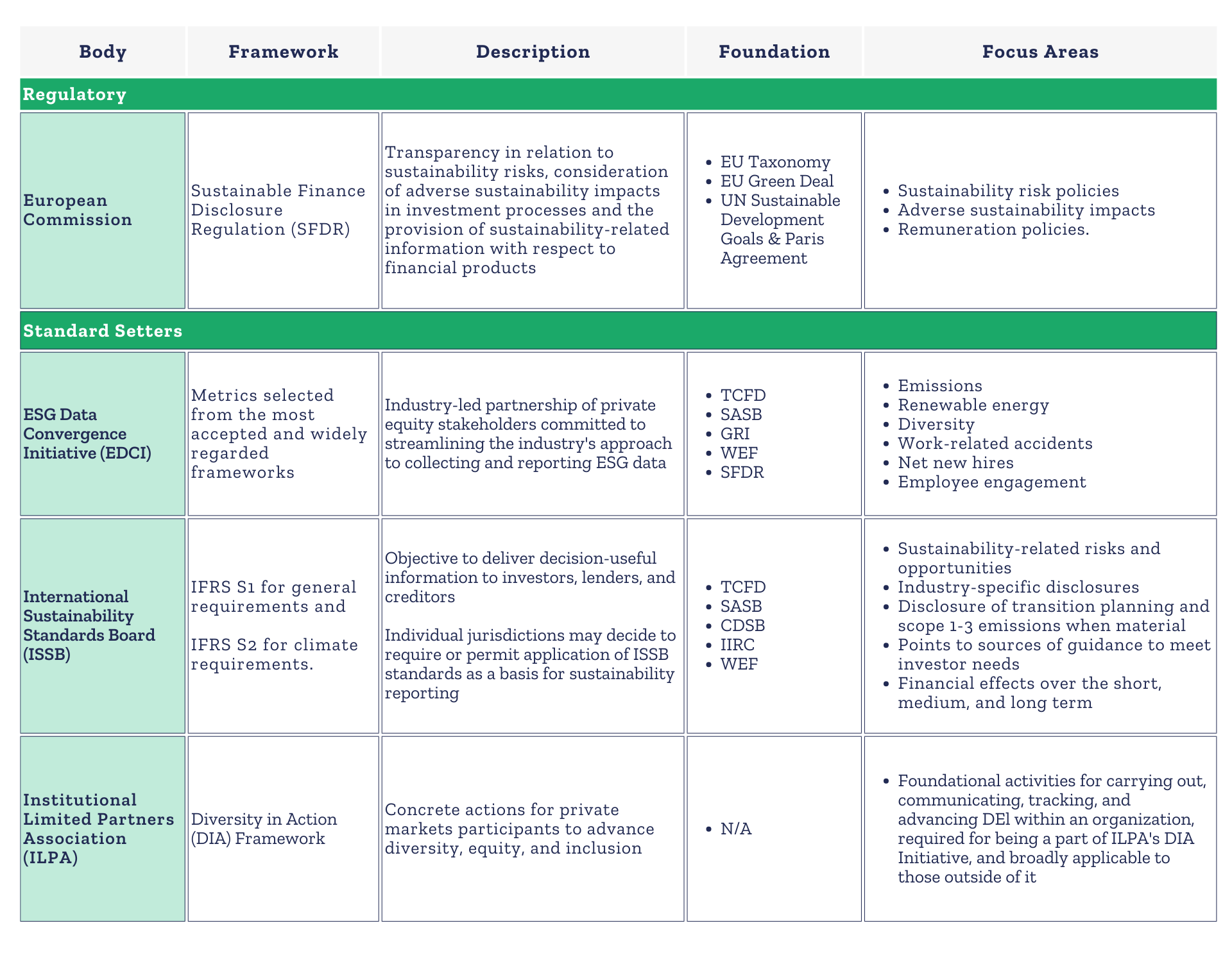
  2.  Taking the critical steps required for effective firm-wide ESG integration, ESG reporting, & ESG compliance. (See table 1 below for a snapshot of the most relevant ESG Regulations & Standards for PE firms today):

Challenges to ESG Integration

Evidently, LPs and GPs recognize sustainability as a strong value driver but, despite evolutions in regulation and investor priorities, sustainability still isn’t mainstream. This is because:

  • ESG encompasses a wide array of topics, from climate change and sustainability to diversity, human rights, consumer protection, and corporate governance. Depending on specific circumstances, certain ESG factors may greatly influence PortCos and funds, while others may not.  Because of this, GPs struggle to prioritize which ESG metrics to report on at all levels (The Metrics Working Group – SMI Private Equity Task Force).
  • Mid-market PE firms with less than $1 Billion in AuM have limited data collection, analysis, and aggregation capabilities at the Fund Level:  LPs are requesting for ESG data at multiple levels, including the PE firm itself, its PortCos aggregated data, and individual PortCo level data. Additionally, this data becomes difficult to compare if all industries and companies are placed in the same peer group.(The Metrics Working Group – SMI Private Equity Task Force).
  • It is difficult for PE firms to collect complete, consistent, and reliable ESG data: GPs must commit valuable time and resources to obtain and measure ESG data from PortCos. The ability to collect ESG data is driven by whether the PortCo has the ability to prepare requested data, as well as the PE firm’s influence and degree of control over the PortCo. Even having a controlling interest does not mean the PE firm controls the day-to-day activities of a PortCo or has direct access to the required information. (The Metrics Working Group – SMI Private Equity Task Force).

Take the first step to tackling these challenges by reading Part 2 of our Critical Success Factors Series for ESG Integration in PE Firms

To learn more about how you can effectively address these challenges and what resources you can use for best-in-class ESG reporting & compliance, sign-up for our newsletter below and read our 4-Part Critical Success Factor Series for ESG Integration in Mid-Market PE Firms. 

About ESGTree

ESGTree provides powerful data solutions to help private equity (PE) and venture capital (VC) firms gather, collect, analyze, benchmark and report their ESG data and that of their portfolio companies. Our carbon calculator, customizable and automated ESG frameworks, multi-level report viewing, trends analysis dashboard, and other features aimed to make ESG a value creation tool rather than a reporting burden.

Click here to learn more about our ESGTree’s ESG software solution for Private Equity & Venture Capital.

With ESGTree, save the time and cost of ESG reporting by harnessing the power of the cloud and streamlining ESG data collection, analysis and disclosure.  

For more information on the ESGTree’s ESG Reporting Solution, please contact us at :

[email protected]

or

Click here to book a demo.

Contact Us

Email

Office Addresses

Canada: ESGTree, CPA 4th Floor, 140 West mount Rd N, Waterloo,
ON N2L 3G6, Canada

United Kingdom: ESGTree, 33 Queen Street, London EC4R 1AP, United Kingdom

Categories
ESGTREE

A Brief Guide to SFDR Reporting and Compliance

A Brief Guide to SFDR Reporting and Compliance

Share:

When the European Union’s Sustainable Finance Disclosure Regulation (SFDR) came into force in March 2021, it signalled to the world that the EU was ready to take a global lead on ESG reporting and sustainable finance.

The move impacted all financial market participants and financial advisors based within the EU. Along with the European Green Deal (which aims to see the bloc carbon neutral by 2050), and the EU’s “green taxonomy” (an industry-based classification system of what can and cannot be marketed as a sustainable product), a potent mix of regulatory mechanisms is set to usher Europe towards an economy in line with the Paris Agreement and the United Nations Sustainable Development Goals (SDGs).

Things are messier in North America. While Canada has opted for mandatory climate disclosures for Crown corporations starting in 2024, its powerful southern neighbour has shown a more chaotic approach to ESG. On the one hand, the US Securities and Exchange Commission proposed compulsory climate reporting for publicly listed US companies, yet the Supreme Court also ruled against the Environmental Protection Agency’s powers to curb greenhouse gas emissions.

Europe’s proactive stance could provide guidance or “lessons learned” for North American responses to the inevitable mainstreaming of ESG. Indeed, SFDR should matter to anyone interested in building the post-pandemic “economy 2.0.”

Update as of December 4th, 2023: The European Supervisory Authorities (ESAs) have recently published a Final Report that outlines proposed changes to the principal adverse impact (PAI) and financial product disclosure regulations under SFDR. These proposed modifications include improvements to sustainability disclosures in the financial sector, the introduction of new social indicators, and a streamlined approach to disclosing PAI associated with investment decisions pertaining to environmental and societal impacts. You can find the comprehensive Final Report by clicking on the following link: Final Report SFDR Amendments.

So, what exactly is SFDR?

SFDR is a set of EU regulations that require asset managers and other financial market participants to publicly disclose ESG information around their investment decisions and financial products, whether or not they are listed as sustainable.

SFDR reporting aims to create a unified set of ESG reporting standards within the EU, thereby increasing transparency around sustainability-related risk, integration and potential impact of financial products available on the market. It combats greenwashing by creating greater transparency around ESG claims, which in turn helps fund managers and other investors compare and contrast the sustainability information of businesses.

Who does SFDR apply to?

Every financial market participant or financial advisor based in the EU must comply with SFDR reporting, across asset classes and including private equity. Non-EU participants marketing funds or products within the EU must also adhere to SFDR regulations for each fund or product they market to EU-based clients (i.e., fund-level disclosures only). Disclosures are required whether or not funds or products are marketed as ESG-focused.

The following deadlines apply to SFDR’s rollout over the course of four years, from its inception in 2021 until mid-2023:

March 10, 2021 – The first provisions of SFDR came into effect, requiring information at the entity level on whether or not a firm currently complies with the regulation.

January 1, 2022 – The first level of alignment with the EU taxonomy classification framework came into effect, requiring additional climate-related disclosures.

January 1, 2023 – The second level of alignment with the EU taxonomy will come into effect, requiring additional disclosures for environmentally-aligned funds. Disclosing the Principal Adverse Impact (PAI) statement (more on this below) at the entity level begins.

June 30, 2023 – The PAI annual statement is to be reported on June 30 every year.

What does the SFDR reporting framework look like?

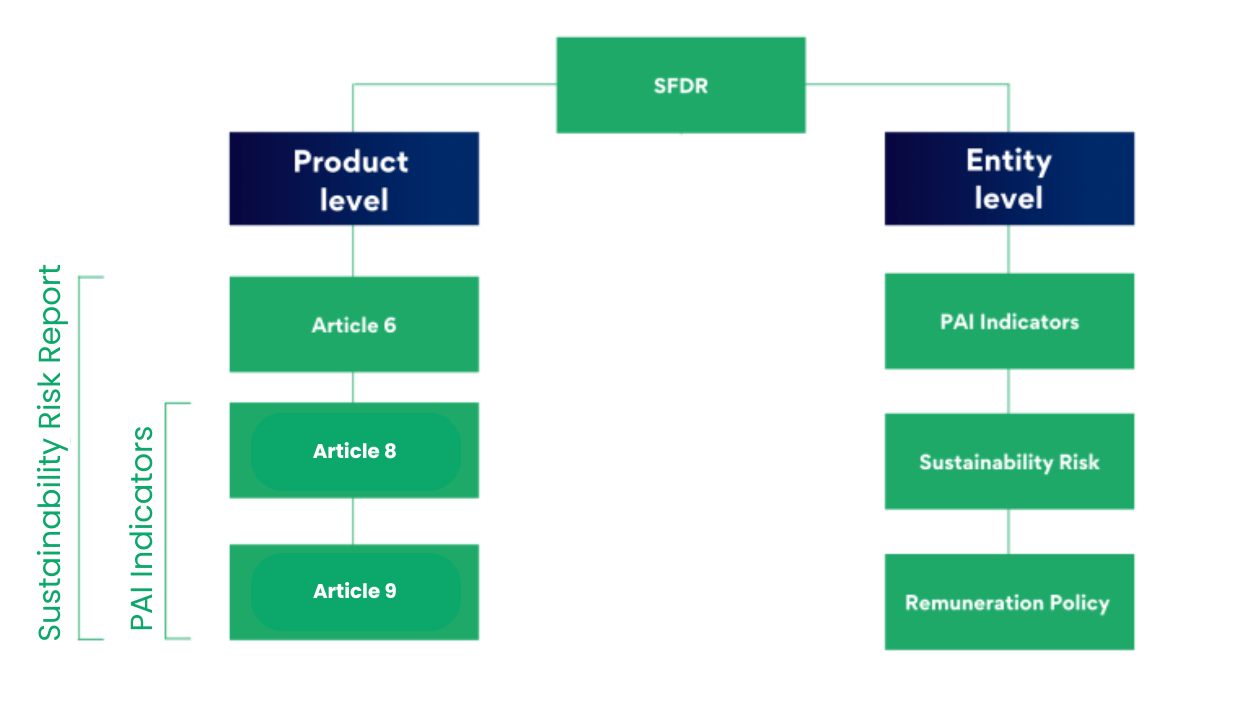
SFDR disclosure requirements can be divided into organization-level reporting and fund/product-level reporting.

At the organization level, firms must at least disclose:

  • the potentially negative impacts an investment decision may have on ESG factors, such as water usage, energy consumption, biodiversity or human rights
  • whether they consider such ESG risks in their investment decision-making process
  • how remuneration policies align with the integration of sustainability risk

At the fund/product level, organizations must at least disclose:

  • How sustainability risk might impact financial performance
  • whether and how the product considers potentially negative impacts on sustainability risk
  • How products labelled as sustainable investments monitor, measure and assess their sustainability impact

SFDR also classifies funds/products into three categories that are subject to their own disclosure rules. They are:

Article 6 Funds: funds that do not integrate sustainability factors into the investment process, and can include investments excluded by ESG funds e.g. tobacco or thermal coal companies

Article 8 Funds: funds that promote and integrate ESG into their investment process

Article 9 Funds: funds that have the objective of sustainable investment

The Principal Adverse Impact (PAI) statement is an integral part of SFDR. It consists of 18 mandatory indicators, and two elective ones chosen from 46 options. These indicators consist of quantitative questions about the potentially negative impact of a fund or organization on ESG factors. These disclosures apply at both the fund and entity level.


How can businesses successfully comply with SFDR?

SFDR is a rigorous regulation. Automating SFDR’s indicators would allow businesses to simplify an otherwise complicated, expensive and time-consuming process. Managing sustainability information in the cloud, rather than through manual mechanisms such as spreadsheets, keeps this data accessible, secure and, importantly, easier to analyze and benchmark to inform strategy and future performance. Technology-based solutions such as ESGTree’s entirely customizable ESG data platform allow investors to monitor, analyze, and benchmark portfolio company performance based on the exact indicators and requirements that are critical to them.

Is SFDR a gamechanger for ESG standardization?

As a comprehensive set of ESG rules, SFDR was devised by regulators themselves, as opposed to recommendations from rating agencies, financial institutions or other member-based organizations and market actors. This makes it the first of its kind, and a robust start to the consolidation of ESG standards globally.

While ESG reporting templates are varied, SFDR is a significant step towards the consolidation and harmonization of ESG worldwide. While public markets are the first affected, the push for greater ESG accountability in private markets is already beginning. Now more than ever, all organizations should train their eye towards staying ahead of regulation and benefiting from strong ESG policies.

For more information on the SFDR Reporting Solution, please contact us at :

[email protected]

 or 

Click here to book a demo.

 ESGTree helps private capital investors stay ahead of regulation and easily collect, analyze and report their ESG data by harnessing the power of the cloud.

Click here to learn more about ESGTree’s ESG Data Management & Reporting Software for Financial Institutions

Carbon Accounting 2022 and Beyond

Carbon Accounting 2022 and Beyond

In February of this year, private equity multinational The Carlyle Group publicly committed to hitting net zero greenhouse gas emissions by 2050 across its entire portfolio. The commitment makes much…

Download a Detailed Guide to SFDR Reporting

Download Our SFDR Reporting Automation Sales Brochure

Summary

Share:

What is SFDR?

Who is required to report to SFDR?

What does the SFDR framework include?

How can SFDR be implemented?

Our GP users have been rated in the top 10% of ESG performers by their LPs

Our GP users have been rated in the top 10% of ESG performers by their LPs

Contact Us

Contact Us

Email

Office Addresses

Canada: ESGTree, CPA 4th Floor, 140 West mount Rd N, Waterloo,
ON N2L 3G6, Canada

United Kingdom: ESGTree, 33 Queen Street, London EC4R 1AP, United Kingdom

Categories
ESGTREE

The IFRS S1 and S2 Standards : What’s New & What’s to Come?

The IFRS S1 and S2 Standards: What’s New & What’s to Come?

Share:

Table of Contents

On 26th June, 2023, the ISSB finally launched its inaugural sustainability standards, ushering in a new era in international corporate reporting

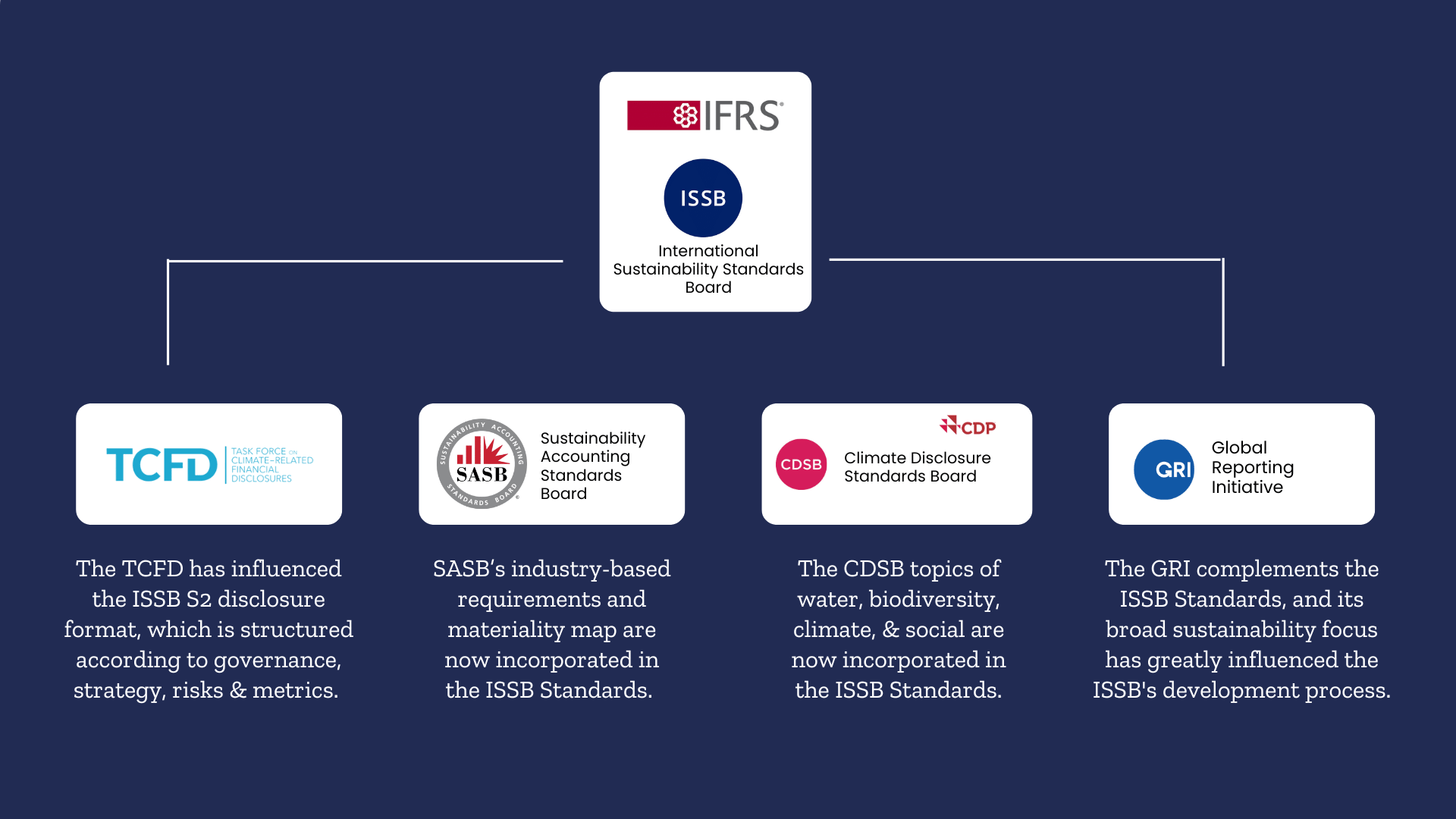
The The International Sustainability Standards Board (ISSB) has issued its first two IFRS Sustainability Disclosure Standards: the IFRS S1 General Requirements for Disclosure of Sustainability-related Financial Information and IFRS S2 Climate-related Disclosures. Both standards fully incorporate the 4 pillars of the Task Force on Climate-related Financial Disclosures (TCFD) as well as the Sustainability Accounting Standards Board (SASB) Standards; both are now subsumed under the ISSB as part of the efforts to establish a global baseline for sustainability reporting.

In this article, we highlight the key changes in the final S1 & S2 standards since the 2022 drafts, explore the implications of the Standards on voluntary & mandatory reporting, and discuss the things to expect from the ISSB in the future. For a more general overview & introduction to the ISSB Standards, click here. 

The IFRS S1 and IFRS S2: What’s New?

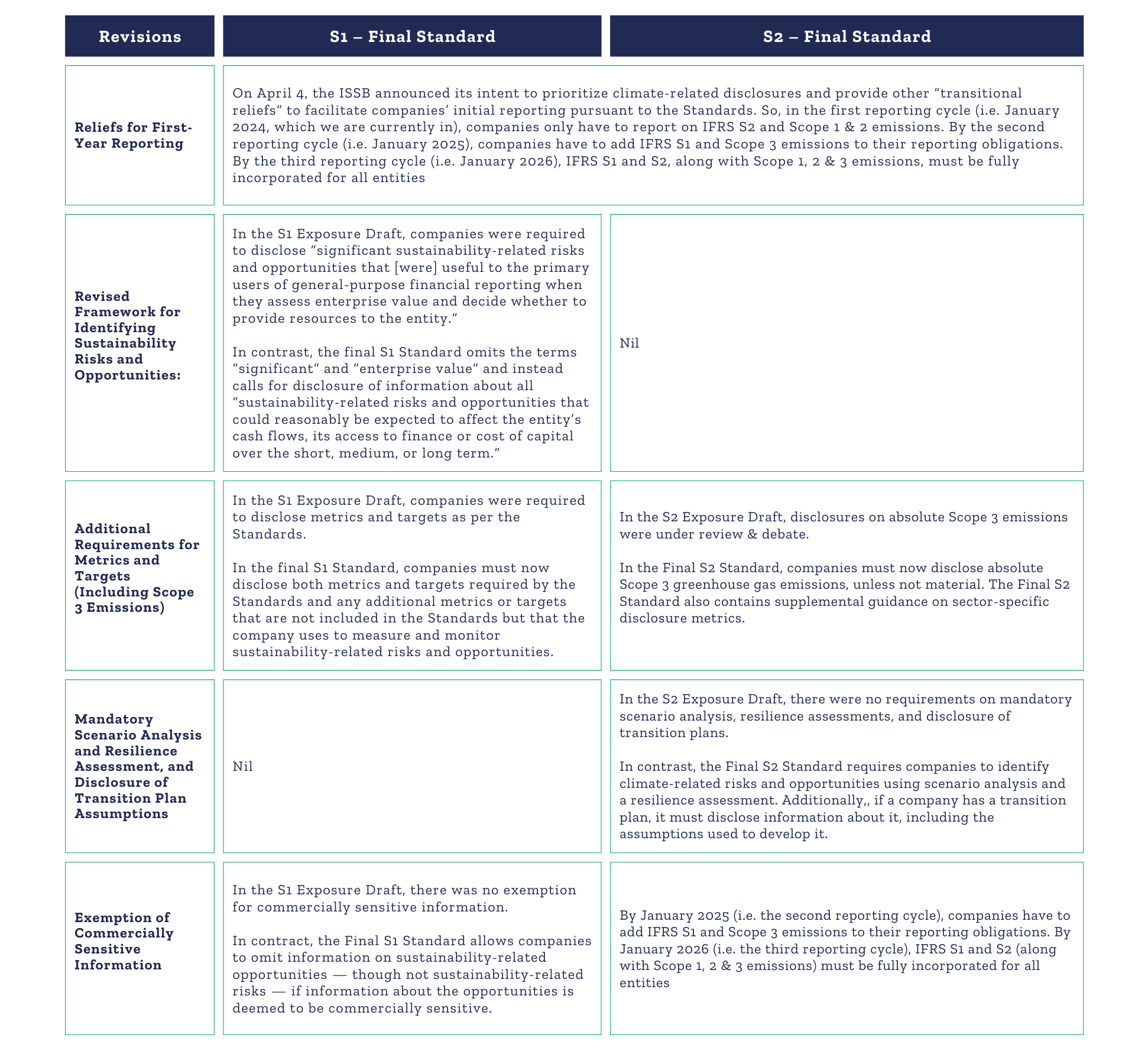
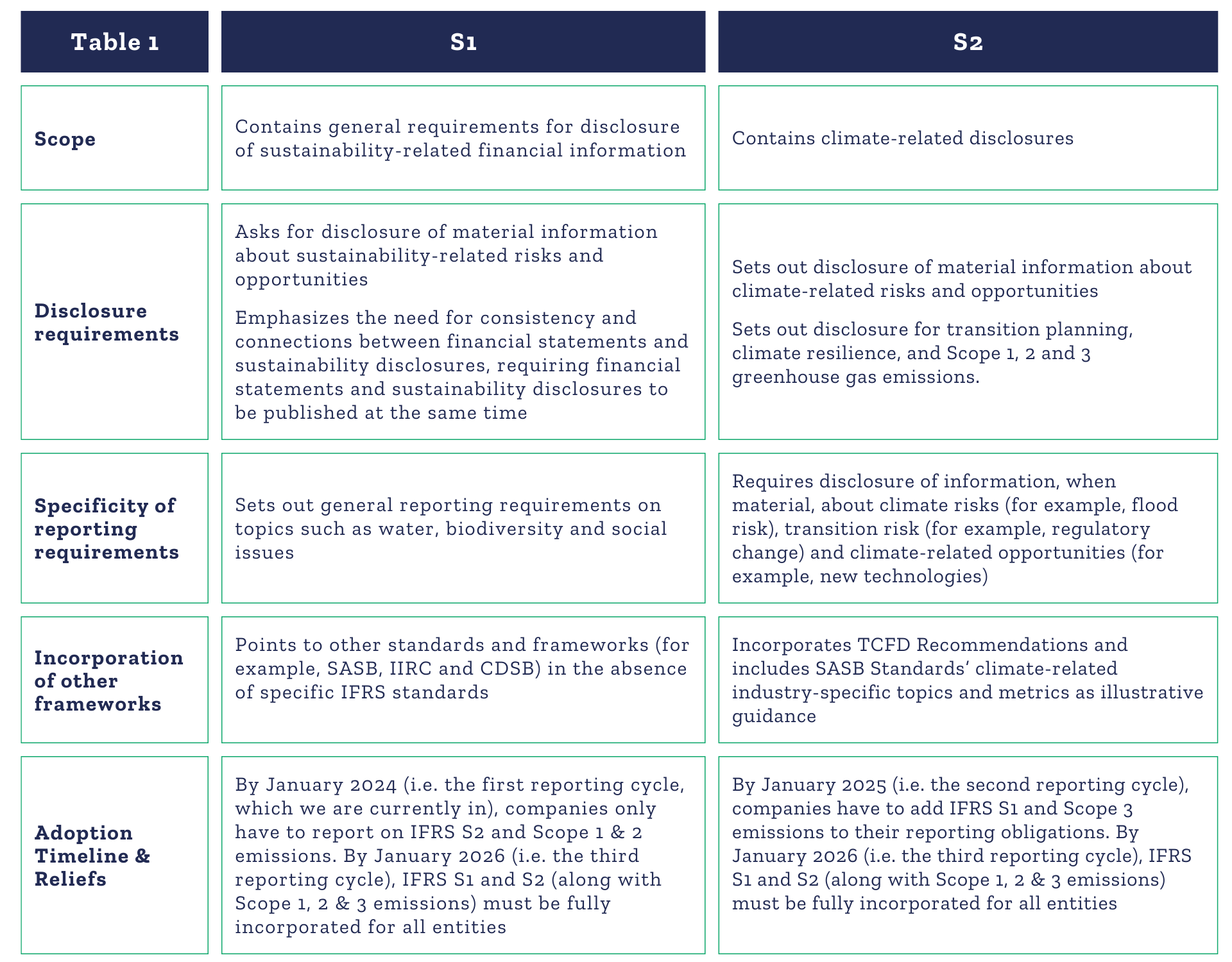
The final Standards incorporate feedback from more than 1,400 global stakeholders and contain several notable changes from the 2022 drafts (see Table 1 below): 

Despite these changes, the Standards continue to lean heavily on industry-specific disclosure topics issued by the SASB and strongly align with the European Sustainability Reporting Standards (ESRS), Global Reporting Initiative (GRI), the Greenhouse Gas Protocol, and many more (see Figure 1 below). 


Potential Impact of S1 & S2 on Voluntary & Mandatory Reporting Regimes

The fact that 1) an advisory group of prominent asset managers from around the world helped the ISSB develop its Standards, 2) influential sustainability reporting organizations like the Principles for Responsible Investment (PRI) are advocating for governments and companies to adopt ISSB-aligned reporting, and 3) the CDP’s 2024 corporate questionnaire aligns with the IFRS S2, indicates that the Standards are already shaping investor expectations and global corporate sustainability reporting. 

In fact, 20 + jurisdictions (including Canada, the UK, Australia, New Zealand, China, & Japan) are already engaged in the adoption process, and a snowball effect is now in occurring, especially since the International Organizations of Securities Commissions (IOSCO) approved the final Standards.  This alone marks a breakthrough for the ISSB Standards, transforming their very nature from Voluntary to Mandatory.

What’s Next for the ISSB?

Additional Standards Forthcoming

As of 2024, the ISSB has moved forward with research projects on two key areas: biodiversity, ecosystems (including ecosystem services), and human capital. These projects were initiated based on the ISSB’s consultation on future priorities and aim to assess how risks and opportunities in these areas impact companies and investors. The ISSB is looking to build on existing frameworks, such as those from the SASB and TNFD (Taskforce on Nature-related Financial Disclosures), to develop more specific disclosure standards within these areas.

For the next two years, the ISSB’s focus will be on developing these research projects, enhancing the SASB Standards, and (most importantly) supporting the implementation of the IFRS S1 and IFRS S2.

Challenges to Adoption & Implementation

While the shift towards Scope 3 reporting and greater climate change disclosure can improve transparency and offer investors more data to make informed decisions, companies will face infrastructural challenges to meet the Standards’ requirements. For instance, companies/financial institutions will have to conduct a substantial amount of first-time data collection in order to comply with ISSB’s data requirements. To do this successfully, they will need to radically shift & revolutionize the way their sustainability data is collected and reported on. 

The good news is that the ISSB has introduced training programmes to support those applying its Standards and has provided “transitional reliefs” to facilitate initial reporting. For specific details on reliefs & adoption timeline, refer “Reliefs for First-Year Reporting” in Table 1 above. While such concessions will ease the reporting burden on many companies, smoothen the transition period, and encourage compliance, companies will still struggle with data gathering, verification, and technical compliance requirements. For companies looking to start their ISSB reporting today, it us essential for them to deploy mitigation strategies that will gear them up for the January 2024 reporting period.

While the adoption of IFRS S1 and S2 may have seemed like a long-shot when they were first introduced, it is clear that they are here and ready to be reported on. In fact, we are currently in the first reporting cycle for the IFRS S1, but there’s a lot of legwork involved in setting up internal reporting capacity. So, early adoption and early assessments are really crucial for setting up that internal capacity in the face of upcoming regulations.

Who Should the Economy Really Serve?

Who Should the Economy Really Serve?

The rallying cry of the American Revolution – no taxation without representation – is today taken as self-evident but deserves a re-examination in light of the climate crisis and sustainable…

Summary

Share:

The IFRS S1 and IFRS S2: What’s New? ​

Potential Impact of S1 & S2 on Voluntary & Mandatory Reporting Regimes ​

What’s Next for the ISSB?

Challenges to Adoption & Implementation

About ESGTree: Simplifying Sustainability Reporting

Contact Us

Contact Us

Email

Office Addresses

Canada: ESGTree, CPA 4th Floor, 140 West mount Rd N, Waterloo,
ON N2L 3G6, Canada

United Kingdom: ESGTree, 33 Queen Street, London EC4R 1AP, United Kingdom

Categories
ESGTREE

What does California’s Climate Corporate Data Accountability Act Mean for ESG?

What does California’s Climate Corporate Data Accountability Act Mean for ESG?

Share:

Table of Contents

Signed into law in October 2023, the California Climate Corporate Data Accountability Act, or SB 253, is a gamechanger for ESG in North America. A first of its kind in the USA, all companies operating in California, whose annual revenue exceeds $1 billion, must now disclose their greenhouse gas emissions data in line with GHG Protocol standards.

Why is SB 253 important?

California is the world’s fifth largest economy. And while ESG has become entangled in America’s culture wars, the blue state has been at the forefront of progressive climate legislation for decades.

“It is very significant that the fifth largest economy in the world – the state of California – now requires large corporations to publicly disclose greenhouse gas emissions across their entire value chain. This landmark legislation will have ripple effects far beyond California’s borders and can serve as a model for national and subnational governments to follow,” attests Director of Greenhouse Gas Protocol Pankaj Bhatia.

SB 253 will function within a suite of complementary measures and regulations aimed at promoting renewable energy and the use of electric vehicles, reducing emissions, and spearheading the widespread adoption of clean technologies. These efforts, combined with ongoing investment in renewable energy infrastructure, position California’s economy to reap the rewards of the transition to net zero while strengthening investor trust.

As similar frameworks emerge both globally and in North America, such as the US SEC’s proposed climate disclosure rule, California’s actions are likely to influence broader regulatory landscapes, promote standardized reporting and foster a more resilient approach to climate risk management in the corporate sector.

What does SB 253 entail?

To successfully comply with SB 253, affected companies will have to:

  • Report their direct emissions, i.e., Scope 1 and Scope 2, for the previous 2025 year
  • Report their indirect emissions, i.e., Scope 3, resulting from their supply chain, in 2027
  • Hire external, independent auditors to verify their disclosures
  • Submit climate reports to a forthcoming digital platform, making this information publicly available

Furthermore, misreporting of Scope 1 and 2 emissions – whether intentional or not – may result in penalties of up to $500,000.

Compliance and implementation

Companies, especially public U.S.-based companies, report on many ESG disclosures and follow many different formats or combinations of frameworks. There is no standardization to reporting yet, which makes it difficult for investors and stakeholders to compare the non-financial information disclosed by different companies. Even though ESG reporting has become the standard, some companies publish this information in different places too. For example, some companies release impact reports that may have a larger focus on their social impact and giving; some companies release sustainability reports with a larger emphasis on environmental sustainability; and others release DEI reports which separate out DEI initiatives and human capital information.

There is a growing movement toward more reporting and more transparency, standardization, and consistency in reporting. The Corporate Sustainability Reporting Directive (CSRD) and accompanying European Sustainability Reporting Standards (ESRS) as well as the SEC Climate Disclosure Rule are making this movement law. Companies must comply with EU reporting as laid out in the ESRS and continue to assess developing regulations from the SEC.

Fortunately, much reporting will align with the Taskforce on Climate Related Financial Disclosures (TCFD) framework, likely the same framework to be used by the SEC.

Reporting of Scope 3 emissions, as required by SB 253, will perhaps be the most difficult. Scope 3 emissions refer to indirect emissions originating from business operations by sources that are not directly owned or controlled by an organization, such as supply chain, transportation, product usage, or disposal. While calculations laid out by GHG Protocol are most widely used, mapping out and calculating emissions for large companies with revenues exceeding $1 billion should not be underestimated.

The power of the cloud

The passing of SB 253 provides yet more evidence of the urgent need for organizations to harness technological innovation to succeed in an economic age where climate resiliency is key to doing business.

ESGTree’s Carbon Calculator allows companies to automatically generate their Scope 1, Scope 2 and Scope 3 emissions by inputting readily available company information, saving time and eliminating the need for external consultants. In tandem, ESGTree’s platform automates TCFD’s reporting framework, automatically generating a TCFD report once users have answered a simple set of multiple-choice questions, along with recommendations on improving performance.

Join the sustainable finance revolution. Join ESGTree.

About ESGTree

ESGTree provides powerful cloud-based data solutions to help private equity (PE) and venture capital (VC) firms gather, collect, analyze, benchmark and report their ESG data and that of their portfolio companies. Our carbon calculator, customizable and automated ESG frameworks, multi-level report viewing, trends analysis dashboard, and other features turn ESG into a value creation tool rather than a reporting burden.

Click here to learn more about ESGTree’s data management and reporting software for private capital investors. 

Who Should the Economy Really Serve?

Who Should the Economy Really Serve?

The rallying cry of the American Revolution – no taxation without representation – is today taken as self-evident but deserves a re-examination in light of the climate crisis and sustainable…

Co-authored by Tia Aftab and ESGTree

Summary

Share:

Why is SB 253 important?

What does SB 253 entail?​

Compliance and implementation

The power of the cloud

Contact Us

Contact Us

Email

Office Addresses

Canada: ESGTree, CPA 4th Floor, 140 West mount Rd N, Waterloo,
ON N2L 3G6, Canada

United Kingdom: ESGTree, 33 Queen Street, London EC4R 1AP, United Kingdom

Categories
ESGTREE

ILPA’s Diversity In Action Framework: A Brief Guide for Private Equity

ILPA’s Diversity In Action Framework: A Brief Guide for Private Equity

Share:

Table of Contents

In the evolving landscape of private equity, stakeholder-calls for transparency and accountability have never been louder. As institutional investors, or limited partners (LPs), increasingly demand comprehensive reporting on environmental, social, and governance (ESG) factors, general partners (GPs) are under pressure to meet these expectations while staying ahead of industry trends. One area of focus is diversity, equity, and inclusion (DEI), a critical component of the broader ESG mandate that is gaining momentum within private markets.

The Institutional Limited Partners Association (ILPA), a leader in setting standards for the private equity industry, has introduced a Diversity in Action (DIA) framework that provides a clear pathway for GPs to address DEI, alongside its established ESG guidance. This framework helps GPs align with LP expectations while promoting a more inclusive and sustainable future. In this article, we explore how ILPA’s Diversity in Action initiative, coupled with best practices in DEI data collection and reporting, can drive meaningful change and enhance value for private equity (PE) firms.

ILPA: A Brief Overview

Established in 2002, ILPA serves as a key trade association for institutional investors/LPs in the PE industry. Headquartered in Washington, DC, the association includes over 500 member organizations from around the world, with the majority based in the U.S., and the rest spread across Canada, Europe, and other regions. Collectively, these members—including pension funds, endowments, family offices, foundations, and insurance companies—represent over $2 trillion in assets under management. ILPA’s retention rate of approximately 97% highlights its role as a central entity in supporting and advocating for its members.

With its core mission to enhance governance and transparency within private equity, ILPA provides a range of resources and frameworks aimed at strengthening investor oversight, promoting best practices, and improving industry transparency. These tools are designed to support GPs and LPs in collecting, analyzing, and sharing relevant financial and ESG  data, furthering transparency across the private equity sector.


The ILPA Due Diligence Questionnaire & ESG Assessment Framework

ILPA’s most downloaded document, its due diligence questionnaire, or DDQ, standardizes common and pertinent due diligence considerations in order to improve the quality of disclosure to LPs and make the reporting process more efficient for GPs. Typically, LPs supplement the ILPA DDQ with ILPA’s ESG assessment framework in order to benchmark GP responses to due diligence efforts, inform goal-setting conversations with GPs and measure ESG integration progress over time. Recently, this framework was updated to reflect the evolution of the ESG metrics and disclosure landscape, including specific references to the ISSB, ESG Data Convergence Initiative (EDCI), and the Private Markets Decarbonization Roadmap.

Relevant Material ESG Indicators

The ILPA DDQ also contains a small ESG section that helps GPs and LPs ensure that ESG considerations are systematically incorporated into investment processes and reporting practices. The relevant DDQ questions pertaining to ESG are summarized below:

  • Policy – does the firm have an ESG investment policy? Is that policy aligned with any international standards or frameworks? How is it monitored and implemented?
  • Fundraising – what are the firm’s ESG commitments when fundraising?
  • Pre-investment – how does the firm determine material ESG risks or opportunities in its portfolio investments?
  • Post-investment – how does the firm contribute to its portfolio companies’ efforts on ESG risk mitigation and value creation?
  • Reporting and disclosure – how does the firm disclose data and provide evidence for its claims?
  • Climate change – how does the firm measure its portfolio companies’ carbon emissions? What are its climate-related commitments and targets? (Include a TCFD report if it reports in line with this framework.)

The ILPA Diversity in Action (DIA) Framework: A Stepping Stone in DEI Reporting

In addition to the ESG section in the DDQ and the supplementary ESG framework, ILPA has introduced the Diversity in Action (DIA) initiative to encourage diversity, equity, and inclusion (DEI) within the private equity sector. This framework outlines foundational practices that LPs and GPs can adopt to promote DEI across all levels of their operations. The framework consists of two parts – four essential criteria and a set of nine optional criteria that span a broader range of possible actions, addressing talent management, investment management and industry engagement. All of the actions prioritized within the DIA framework are drawn from ILPA’s D&I Roadmap, which houses all of the best practices and resources for GPs and LPs to consider at each stage of the development and implementation of their own DEI programs.

The DIA Framework’s Foundational Required Activities – All 4 of the Following

Participating organizations agree that their DEI actions include a combination of the foundational activities indicated below:

  • Having a DEI statement or strategy in place that is communicated publicly, and/or a DEI policy communicated to employees and investment partners that addresses recruitment and retention. The former also includes addressing harassment, either within the DEI policy itself or within a separately articulated policy or statement
  • Tracking internal hiring and promotion statistics by gender and race/ethnicity
  • Putting in place organizational goals that result in demonstrable practices to make recruitment and retention more inclusive
  • Requests LPs for or provides GPs with DEI demographic data via the ILPA Diversity Metrics Template for any new LP commitments or new GP fundraises

Added in 2023, the DEI Monitoring Questionnaire, modeled on ILPA’s DDQ,, is meant to guide the efforts of investors looking to foster more regular touch points with managers to better understand their DEI trajectory over time. 

ILPA DIA: Data Collection & DEI Reporting Best Practices

What the Market Has Shown Us:

  • The Rise of Data Collection: DEI data collection has hit an all-time high, with more LPs requesting demographic data and GPs increasing the data they are collecting at the firm and portfolio company level. According to a McKinsey report, The State of Diversity in Global Private Markets 2023, firms are now reporting DEI metrics with greater frequency than years past, with 52% reporting on management, investment team, and portfolio company boards. LP demand is a primary driver of these trends. With a growing number of allocators pressing managers for this information, GPs are finding it increasingly important to disclose. 
  • The Importance of Standardization: The demand for standardization in data collection and reporting is also increasing, with firms looking for ways to streamline the process of DEI data collection. Resources like the ILPA DDQ and Diversity Metrics Template exist to alleviate the burden on firms as they respond to a record number of requests from investors for demographic data. Other industry initiatives, like the ESG Data Convergence Initiative (EDCI), attempt to standardize how ESG and DEI data is collected at the portfolio company level. In fact, many  of our clients have used a hybrid framework to comply with LP requests by supplementing  EDCI with enhanced diversity metrics from the ILPA DIA. Read our Client Case Study to learn more about how we helped a PE firm improve its DEI metrics & impact.
  • Senior-Level Oversight & Accountability for DEI: LPs have come to expect that GPs are not only able to clearly communicate their DEI goals as a part of diligence and monitoring conversations, but can also discuss how senior leaders at their firms are accountable for these goals and driving associated outcomes. Three-fourths of DIA signatories report having processes in place that include senior-level oversight for DE&I outcomes. 
  • Action-Oriented Goal Setting: Any signatories to the DIA tend to prioritize action-oriented goals over metrics-based targets. This is particularly true in smaller organizations where metrics are heavily influenced by the gain or loss of only a few employees. Increasingly, GP signatories discuss viewing goal setting as a collective effort, drawing from their engagement externally with asset owners and internally with employee working groups, as opposed to more traditional top-down goal setting processes. In practice, signatories employ a variety of approaches to goal setting. Some of the most popular goals  center on:
    • Diversifying recruitment pipelines by investing in on-campus activities and  emphasizing the importance of representation when leveraging search firms 
    • Improving employee engagement, leveraging employee surveys to understand opportunities and monitoring progress and internal committees to drive inclusion 
    • Improving internal processes associated with collecting (where permissible) DEI data and tracking improvement over time 
    • Developing and promoting DEI best practices at portfolio companies, both at the board level (i.e., improving representation on portfolio company boards) and at the firm level 
    • Establishing resource networks at the firm level that bring leadership across companies together to discuss shared challenges and helpful resources
  • LP signatories are quick to acknowledge that the industry has a long way to go. Several LP signatories have noted that requests for DEI data are not being used in a punitive way and instead being used to set a baseline with the hope that conversations today can shine a light on areas where progress can be made over time.

Automating DEI Data Collection and DEI Reports – DEI Reporters

Steadfast LP demand for transparent ESG and DEI practices is being heard, as evidenced not only by the growing number of sustainability jobs but by the significant raising of their salaries as well.

However, conceiving and implementing an ESG roadmap begins with data, something this new class of professionals will have to contend with. The world is still at a point where differing sustainability frameworks and ESG rating systems are slowly coalescing, helped along by regulation, into something more concrete. In such an environment, GPs can stay ahead of the curve, and save themselves much hassle and headache, by automating their data collection and using cloud-based systems to  analyze and report it.

This point is further substantiated by the discussions held in the the third DIA roundtable in August 2024, where signatories explored the current state of DEI metrics and reporting, including emerging best practices for data collection in the private markets industry. The roundtable revealed that, while firms can take a variety of approaches to collecting and aggregating ESG and DEI data,  firms that lack the resources to build robust internal data collection platforms are frequently leveraging service providers and consultants to aid in the process. 

ESGTree: An ESG and DEI Data Management & Reporting Solution for Private Markets

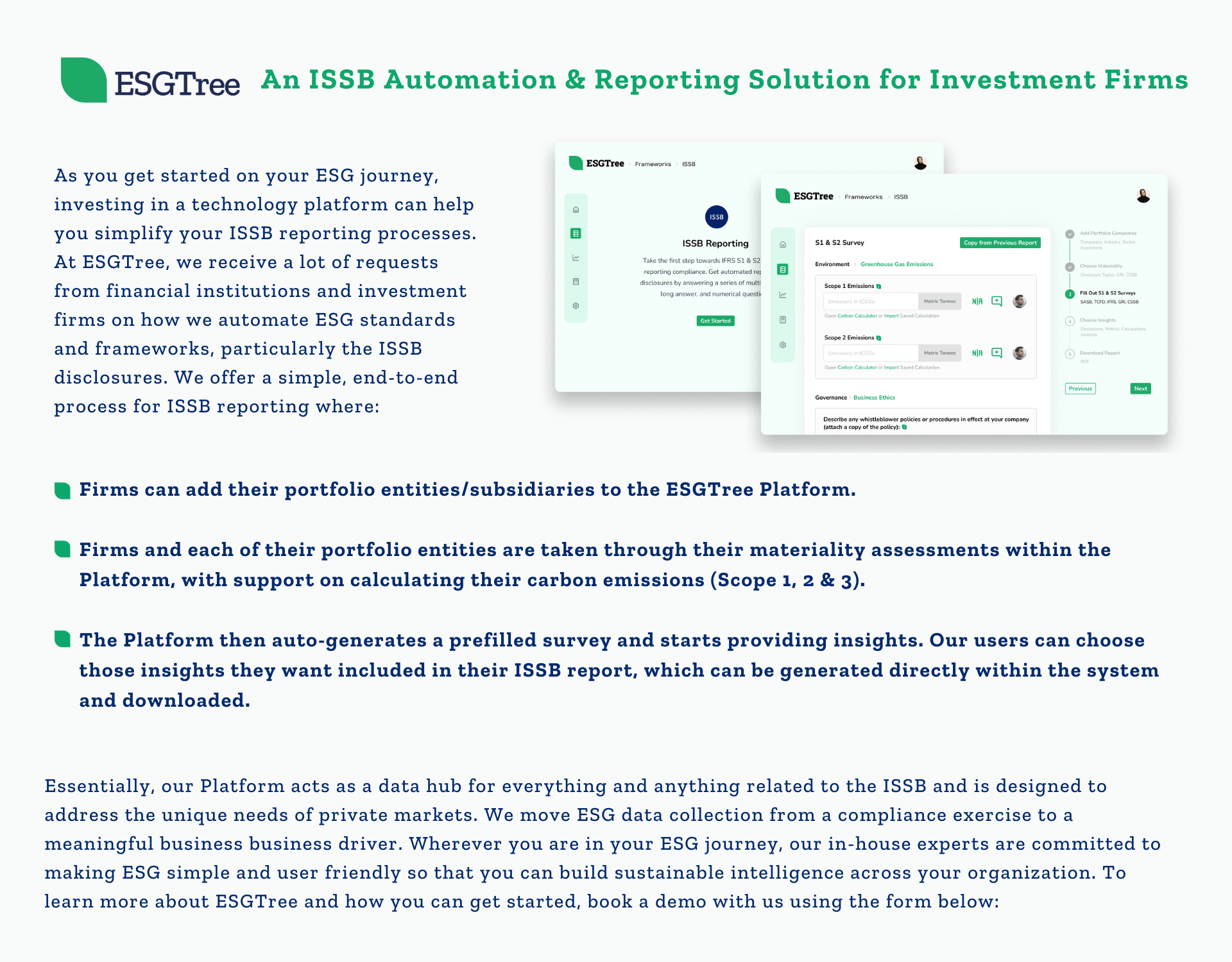
ESGTree’s ESG and DEI reporting data management platform is designed to address the unique needs of the private markets with a simple, clear, and customized solution to help you easily collect, report, and analyze ESG data. ESGTree provides:

  • A clear starting point for GPs to confidently choose what to measure and track
  • A seamless data collection process with in-platform guidance and support for PortCos
  • Insightful reporting and analytics to track and manage ESG and DEI data across the portfolio
  • Automations for multiple ESG and diversity frameworks like the IFRS S1 and S2, SFDR, PCAF, California SB54, BDC DEI, and ILPA DIAEngineering support to ensure that overlaps in metrics are added only once

In fact, our Industry Report on GP Sentiments around LP Data Requests revealed that tech-enabled service providers like ESGTree provide immense value to GPs by delivering flexible solutions that can:

  • Standardize the taxonomy of ESG and DEI
  • Provide independent ESG assessments and benchmarks
  • Offer GPs flexibility in adhering to different standards that are frequently changing

Every single GP that we interviewed for this Report admitted that if they had a centralized platform to house all DDQs, it would help them give LPs  better-quality answers, drive sounder ESG policies, and boost overall LP portfolio performance. Opportunely, our proprietary software not only supports GPs through DDQ automation, but our in-built collaboration tools allow for easy access to synthesized data across departments, driving the necessary organizational shifts to harness the power of ESG.

ESGTree provides advanced ESG data management solutions using the power of the cloud. Our automated platform is specifically geared to help private equity (PE) and venture capital (VC) firms manage their ESG data collection, analysis and reporting needs. Additional features such as our carbon calculator, benchmarking technology, and other trends and analysis features make ESGTree one of the most advanced SaaS solutions to ESG reporting for investors.

Click here to learn more about ESGTree’s ESG Data Management & Reporting Software for Financial Institutions

Who Should the Economy Really Serve?

Who Should the Economy Really Serve?

The rallying cry of the American Revolution – no taxation without representation – is today taken as self-evident but deserves a re-examination in light of the climate crisis and sustainable…
Categories
ESGTREE

FAQs about the Corporate Sustainability Reporting Directive (CSRD)

Frequently Asked Questions about CSRD

Share:

Co-authored by Rohit Adlakha and ESGTree

What is CSRD?

The acronym CSRD stands for Corporate Sustainability Reporting Directive and was drafted by the European Commission in April 2021. This new European regulatory framework for sustainability was published on December 16, 2022, in the Official Journal of the EU. CSRD is known as the Gold Standard for sustainability reporting frameworks as it considerably enlarges the scope of companies that must disclose sustainability information and brings forward new requirements.

The CSRD went into effect on January 5, 2023, and EU Member States have until early July 2024 (18 months from the effective date) to incorporate its provisions into national law. The directive sets forth the baseline, thus Member States may add provisions during this period but cannot eliminate any of the requirements in the CSRD.

Who does it impact?

The CSRD targets financial and non-financial companies covered by the Accounting Directive and the Transparency Directive, and falling into the following categories:

  • Companies listed on European regulated markets, including listed SMEs (micro-enterprises identified by the Accounting Directive are excluded);
  • Other large European companies, listed or not, exceeding two of the three defined thresholds (250 employees, 40 million euros in revenue, and/or 20 million euros in total assets);
  • Non-European companies whose subsidiaries or branches have revenues exceeding 150 million euros within the European Union.

What are the legal implications?

Given that the broad array of potential impacts from non-compliance with the CSRD may be far reaching — ranging from monetary fines to negative reaction of stakeholders — companies should discuss any potential non-compliance with legal counsel. Direct impacts may include a breach of certain contractual arrangements (including debt agreements) due to non-compliance with laws and regulations, and may also impact an entity’s ability to work with local, state, or national governments. In addition, companies should be aware that failure to comply may not only result in a qualified or adverse opinion on the sustainability report but may also impact the audit opinion on the financial statements. Auditing standards include requirements related to “other information” included in a document that includes an audit opinion. A material omission of information from the sustainability report would need to be disclosed in the financial statement audit opinion. In addition, intentional noncompliance with laws and regulations may have broader impacts on the audit of both the entity itself and its parent, if applicable. For example, noncompliance may impact the nature, timing, and extent of audit procedures, the auditor’s ability to rely on management’s representations, and the determination of whether there is a significant deficiency or a material weakness related to the control environment.

When is reporting required and by who?

The CSRD reporting timeline is phased in, with different requirements based on company size and previous reporting obligations. Here’s a breakdown:

Who and When:

  • Large public-interest companies (over 500 employees) already subject to NFRD
  • Compliance: Financial year 2024 (reports due in 2025)
  • Large companies not previously subject to NFRD (over 250 employees and/or €40 million turnover and/or €20 million in total assets)
  • Compliance: Financial year 2025 (reports due in 2026)
  • Listed SMEs and other undertakings
  • Compliance: Financial year 2026 (reports due in 2027)
  • Opt-out option: SMEs can choose to opt out until January 1, 2028.

What are the challenges that could come up?

1. Complexity and Scope:

a) Extensive Reporting: The CSRD demands detailed reporting on environmental, social, and governance (ESG) factors across many areas, covering topics like climate change, human rights, and responsible production. Adapting to these expansive requirements can be complex.

b) Data Collection and Management: Gathering and integrating accurate data from various sources across the value chain can be time-consuming and challenging. The sheer volume of data points required (over 1,200) adds to the difficulty.

c) Standardization and Interpretation: The new European Sustainability Reporting Standards (ESRS) are still under development, leaving room for potential ambiguity and differences in interpretation. Companies need to stay updated and seek guidance to ensure compliant reporting.

2. Resource and Cost Implications:

a) Compliance Expenses: Implementing the CSRD can require significant investments in new technologies, staff training, and external support like auditors. This can be especially burdensome for smaller companies.

b) Internal Capacity and Expertise: Adapting internal processes and building employee expertise in sustainability reporting can be a challenge, especially for companies without prior experience.

3.Stakeholder Engagement and Assurance:

a) Identifying and Engaging Stakeholders: The CSRD emphasizes meaningful stakeholder engagement to understand sustainability impacts. This requires proactive outreach and effective.

b) Independent Assurance Costs and Challenges: Finding qualified auditors for mandatory third-party assurance may be challenging, especially for smaller companies. The cost of these services can also be significant.

4. Additional Challenges:

a) Greenwashing Concerns: Companies face scrutiny to ensure their reporting accurately reflects their sustainability efforts. Avoiding greenwashing is crucial.

b) Evolving Regulatory Landscape: The CSRD and related standards are subject to future updates and revisions, requiring companies to adapt their compliance approaches over time.

What are the risks?

  1. Increased Costs and Complexity: Implementing the CSRD requires investments in data collection, reporting systems, staff training, and external services like auditors.
  2. Greenwashing Concerns: Companies face scrutiny to ensure their reported sustainability achievements match their actual practices. Stringent regulations and stakeholder attention can be challenging to navigate.
  3. Data Management and Quality: Gathering and ensuring the accuracy and reliability of vast amounts of sustainability data across the value chain can be complex and time-consuming. Deficient data can lead to inaccurate reporting and reputational damage.
  4. Evolving Regulatory Landscape: The CSRD and related standards are still under development and subject to future changes. Companies need to adapt their compliance approaches as the regulations evolve.
  5. Limited Expertise and Resources: Smaller companies might lack the internal expertise and resources to effectively implement the CSRD, requiring significant external support, adding to costs and potential dependency.

What are the opportunities?

  1. Enhanced Reputation and Brand Value: Demonstrating strong sustainability performance through transparent and comprehensive reporting can enhance brand reputation, attract ethical investors, and strengthen stakeholder relationships.
  2. Improved Risk Management: Implementing robust sustainability practices can identify and mitigate environmental, social, and governance risks, leading to long-term cost savings and operational efficiency.
  3. Innovation and Competitive Advantage: The CSRD can drive innovation in sustainable products, services, and processes, potentially opening up new markets and creating a competitive edge.
  4. Attracting and Retaining Talent: Transparency and commitment to sustainability can attract and retain talent who value purpose-driven organizations, contributing to employee engagement and morale.

ESGTree provides powerful cloud-based data solutions to help private equity (PE) and venture capital (VC) firms gather, collect, analyze, benchmark and report their ESG data and that of their portfolio companies. Our carbon calculator, customizable and automated ESG frameworks, multi-level report viewing, trends analysis dashboard, and other features turn ESG into a value creation tool rather than a reporting burden.

Click here to learn more about ESGTree’s data management and reporting software for private capital investors. 

References: EY, PWC, IBM, Grant Thornton, Deloitte, KPMG

Who Should the Economy Really Serve?

Who Should the Economy Really Serve?

The rallying cry of the American Revolution – no taxation without representation – is today taken as self-evident but deserves a re-examination in light of the climate crisis and sustainable…

Summary

Share:

What is CSRD?

Who does it impact?

What are the legal implications?

When is reporting required and by who?

What are the challenges that could come up?

What are the risks? What are the opportunities?

Contact Us

Contact Us

Email

Office Addresses

Canada: ESGTree, CPA 4th Floor, 140 West mount Rd N, Waterloo,
ON N2L 3G6, Canada

United Kingdom: ESGTree, 33 Queen Street, London EC4R 1AP, United Kingdom

Categories
ESGTREE

How Can Private Equity Position Itself for the US SEC’s Climate Disclosure Rules?

How Can Private Equity Position Itself for the US SEC’s Climate Disclosure Rules?

Share:

Table of Contents

On March 6th 2024, the United States Securities and Exchange Commission (SEC) released its highly anticipated climate-related disclosure rules for public US companies.

Originally published in March 2022, the SEC proposed that all publicly listed US companies be mandated to report their climate data in alignment with reporting recommendations from the Taskforce on Climate-related Financial Disclosures (TCFD).

When the proposal was then opened for public comment, the SEC received over 3,400 letters, significantly more than it customarily does when seeking public input.

While the SEC ruling applies to public companies, given the current global regulatory environment and calls for greater scrutiny of ESG claims within the private equity industry, it is only a matter of time before similar climate considerations be asked of private funds. Moreover, although the proposal will almost certainly face some measure of legal challenges, this will likely not deter 98% of companies from implementing climate reporting, according to a PricewaterhouseCoopers survey of 300 senior executives at US public companies with at least $500 million in revenues.

A deeper look at the SEC Proposal

The SEC’s final climate disclosure rule (i.e. the Final Rule) aims to provide investors with consistent and comparable information with which to examine the sustainability and climate risk profile of potential investments. It is also wide-ranging, covering the disclosure of greenhouse gas (GHG) emissions, predicted climate risks, and sustainability transition plans. Some if its main disclosure provisions include:

  • Scope 1 and 2 GHG emissions by large Accelerated Filers (LAFs) & Accelerated Filers (AFs) on a phased-in basis, accompanies by an attestation report. 
  • Potential risks to and material impacts on an organization resulting from climate change, aligned with TCFD disclosure recommendations
  • Quantitative and qualitative financial impacts of climate-related events such as severe weather events
  • Governance and risk management-related information including scenario analyses, physical risks, transition risks, transition plans and other climate-related programs such as the use of carbon offsets or internal carbon pricing

Companies have a phased-in period to comply with the Final Rule, and the deadline depends on: 1) their filing status (i.e. whether they are an LAF, AF, a Non-Accelerated Filer (NAF),  Smaller Reporting Company (SRC), or an Emerging Growth Company (EGC)) and 2) the content of their disclosure. In general, LAFs have the shortest time window to comply with the Rule, followed by AFs, and then SRCs, NAFs, and EGCs. 

The Final Rules will become effective 60 days after publication in the Federal Register.

An opportunity for private equity?

Though the SEC proposal applies to public markets, there are three potential avenues for direct overlap with private markets:

  • Publicly traded private equity firms: Private equity firms traded on the stock market, along with their portfolio companies, would be subject to SEC rules
  • Private equity portfolio companies going public: When making an Initial Public Offering (IPO), SEC-mandated climate information would need to be disclosed
  • Private equity firms that are Registered Investment Advisors (RIAs): If adopted, the Proposed Rules would be the first time that the SEC has required disclosure of a specific aspect of the investment process by Registered Investment Advisors (RIAs).

Critically, in contrast to public markets, private equity and venture capital markets have direct responsibility for the companies or start-ups they invest in, often holding board seats in these companies. This direct-stakes approach to raising capital, along with the responsibility to their own board members who typically have considerable wealth at risk, means private capital firms will be held to a far higher standard of accountability as ESG regulation continues to tighten worldwide. Venture capital firms, in particular, have an opportunity to integrate ESG into their portfolio companies from the get-go during the early stage of a company’s life cycle.

How can private equity prepare for the SEC’s disclosure rules?

Given the unique nature of private equity to position itself as an ESG leader, the following areas may be considered when formulating a climate accounting strategy:

  • Begin with a baseline collection of solid, reliable and verifiable data before crafting strategies and policies. Data is the edifice upon which ESG strategy rests.
  • Embed ESG considerations into all stages of the investment lifecycle, from pre-deal assessments to exit plans
  • Conduct a gap analysis by reviewing all current disclosure policies
  • Conduct an audit of all greenhouse gas emissions related to portfolio companies
  • Consider greenhouse gas emissions resulting from the supply chain: prioritize those suppliers with strong ESG credentials
  • Leverage technology solutions to streamline and automate ESG reporting

If you are a Private Equity firm that is also an RIA, further planning and consideration may be required when formulating your climate accounting strategy since an additional specific set of disclosure requirements will apply. In this case, you can prepare for the upcoming SEC disclosure mandate by: 

  • Determining the applicable fund category: Whether and how the SEC’s Proposed Rules will impact an RIA depends primarily on which of the 3 ESG fund types (i.e. “ESG Integration,” “ESG-Focused,” and “ESG Impact”) apply to the RIA’s investment decisions.
  • Tailoring your marketing and advertising policies to the new ESG fund-type classification system: RIAs should be deliberate about the publication of marketing & sales collaterals that indicate the significance of ESG factors in investment decision-making, as this could unintentionally lead to enhanced disclosure obligations
  • Creating consistent internal policies regarding the use of ESG metrics: seeing how a key focus of SEC’s Proposed Rules for RIAs is the consistency of disclosures in their prospectuses, annual reports and brochures.

Technology: the missing piece

Technology will play a paramount role in successful ESG compliance – a belief echoed by a majority of business leaders.

Keeping the needs of private capital investors in mind, ESGTree has developed several climate reporting tools to collect, analyze, and automate this data and simplify reporting.

These include:

  • An automated TCFD reporting tool: ESGTree’s cloud-based software boils down the reporting process to 40 simple multiple-choice questions that, upon completion, automatically generate the TCFD report.
  • An automated Partnership for Carbon Accounting Financials (PCAF) tool: Automating this framework allows organizations to calculate their financed emissions i.e. emissions associated with their loans and investments
  • Carbon Calculator: ESGTree’s Carbon Calculator allows staff members themselves to generate Scope 1, 2 and 3 GHG emissions using basic information about company operations. Our clients have reported a 70% reduction in the time it takes to calculate this information.

The SEC’s climate disclosure rules do not exist in a vacuum. As more regulators across the world toughen ESG rules, consolidate standards and crack down on greenwashing, the private equity industry is well-placed to lead the transition to a more sustainable, low-carbon economy.

For more information on the Final U.S. Securities and Exchange Commission (SEC) Climate Disclosure Rules, click here to download the official SEC Rules Document. 

ESGTree provides powerful cloud-based data solutions to help private equity (PE) and venture capital (VC) firms gather, collect, analyze, benchmark and report their ESG data and that of their portfolio companies. Our carbon calculator, customizable and automated ESG frameworks, multi-level report viewing, trends analysis dashboard, and other features turn ESG into a value creation tool rather than a reporting burden.

Click here to learn more about ESGTree’s data management and reporting software for private capital investors. 

Who Should the Economy Really Serve?

Who Should the Economy Really Serve?

The rallying cry of the American Revolution – no taxation without representation – is today taken as self-evident but deserves a re-examination in light of the climate crisis and sustainable…

Summary

Share:

What is the US SEC climate disclosure proposal?

Why should private equity care about the SEC climate proposal?

How can private equity prepare for the SEC’s disclosure rules?

How can technology be leveraged to report climate data?

Contact Us

Contact Us

Email

Office Addresses

Canada: ESGTree, CPA 4th Floor, 140 West mount Rd N, Waterloo,
ON N2L 3G6, Canada

United Kingdom: ESGTree, 33 Queen Street, London EC4R 1AP, United Kingdom

Categories
ESGTREE

The Regulatory Rise of TCFD Reporting

The Regulatory Rise of TCFD Reporting

Share:

Table of Contents

The Taskforce on Climate-related Financial Disclosures (TCFD) has arguably become the dominant framework for reporting climate data, as evidenced by a number of recent regulatory moves:

The Rise Of TCFD Reporting

  • The United Kingdom now mandates TCFD-aligned reporting requirements for the private sector. 
  • The United States Securities and Exchange Commission (SEC) requires publicly traded US companies to disclose climate data based on TCFD recommendations. 
  • Beginning in 2024, all federally regulated financial institutions in Canada will have to report climate data in line with TCFD.  
  • The governments of Brazil, the European Union, Hong Kong, Japan, New Zealand, Singapore and Switzerland have announced requirements for climate disclosures informed by TCFD recommendations to be implemented by various timelines. 

What exactly is TCFD?

The TCFD framework is the brainchild of the Financial Stability Board (FSB), the Switzerland-based international body that makes recommendations on the global financial system. Released in 2017, its recommendations aim to help companies release meaningful climate data as the world attempts to transition to a low-carbon economy. 

The taskforce itself is chaired by Michael Bloomberg (founder of Bloomberg LP and former mayor of New York City) and consists of 31 members from across the G20 countries, including executives from Unilever, BNP Paribas, JPMorgan Chase, and BlackRock among others. 

TCFD boasts over 2,000 supporters across the globe, in the form of governments, financial institutions and the private sector. The 1,069 financial institutions that have so far openly supported TCFD together represent USD$194 trillion in assets under management. 

The Four Pillars of TCFD

The framework itself consists of 11 disclosure recommendations spanning four interrelated thematic areas: governance, strategy, risk management, and metrics and targets. With the exception of the last area, these recommendations are largely qualitative in nature, and can be summarized as follows: 

Governance: companies should disclose their management and board’s strategy for monitoring and assessing climate risk (and opportunity). 

Strategy:  companies should identify climate risks and opportunities foreseen over the short, medium and long term; explain the impact of these risks and opportunities on their planning and operations; and assess how resilient their strategy is in various climate-related scenarios (i.e., climate stress tests). 

Risk Management:  companies should explain their process for identifying and managing climate risk and how this process fits into the overall picture of risk management. 

Metrics and Targets: companies should disclose the specific metrics used to inform their climate strategies, including the disclosure of scope 1, 2, and 3 greenhouse gas emissions among other conventional metrics. They should also disclose climate goals or targets and their progress towards them. 

Challenges and Solutions to Implementing TCFD for Private Equity

Although the TCFD report is short and largely qualitative, it nevertheless poses an additional burden to organizations that, at present, face different ESG reporting requirements from their investors with little support or direction on how to implement them. 

Given its relative newness, gathering and comparing climate data remains a major challenge for organizations. The larger the portfolio is, the more difficult it is to capture this data. And given that even large organizations struggle with this, small and medium-sized enterprises have even fewer resources to tackle data collection and analysis. Take, for example, calculating Scope 3 greenhouse gas emissions – i.e. emissions resulting from a company’s supply chain – which are out of the direct control of a company. 

Collecting information on climate risk is also complex because the data is not isolated, but rather a part of an interconnected system. While companies already have a handle on more traditional financial risk, with a standard set of operating procedures, it is not enough to tackle climate data in an isolated fashion. This is why, as part of ESGTree’s TCFD automation tool, we often recommend involvement at the Board level on climate strategy. 

ESGTree's TCFD Tool for Private Equity

To simplify the TCFD reporting process, ESGTree’s cloud-based software boils down the reporting process to 40 simple multiple-choice questions that, upon completion, automatically generate the TCFD report, thereby automating much of the difficult legwork. Based on the responses to the questions, ESGTree is able to provide recommendations and action items on how to improve a company’s climate performance vis-a-vis the four pillars of the framework. 

This is complemented by ESGTree’s automated Carbon Calculator which allows for seamless calculation of carbon emissions by taking in data that companies easily have on hand and providing the figures for 1, 2, and 3 emissions immediately.  

Given the legislative action and international buy-in of TCFD, it is advisable to add TCFD to your climate action plan now rather than later in order to stay ahead of the regulatory curve and minimize transition risk as the world moves towards a lower carbon economy. 

ESGTree’s automated and customizable ESG frameworks help private market investors stay on top of the ESG performance of their portfolio companies. Private equity (PE) and venture capital (VC) firms and other financial institutions rely on ESGTree’s multi-layered platform to collect, analyze, benchmark and report ESG data hassle-free.

Who Should the Economy Really Serve?

Who Should the Economy Really Serve?

The rallying cry of the American Revolution – no taxation without representation – is today taken as self-evident but deserves a re-examination in light of the climate crisis and sustainable…

Summary

Share:

What is TCFD?

Where has TCFD been regulated?

How is TCFD structured?

How can TCFD be implemented?

Categories
ESGTREE

The ISSB Standards: A Milestone in the Global Economy 

The ISSB Standards: A Milestone in the Global Economy

Share:

Table of Contents

On 26th June, 2023, the ISSB finally launched its inaugural sustainability standards, ushering in a new era in international corporate reporting

The International Sustainability Standards Board (ISSB) has issued its first two IFRS Sustainability Disclosure Standards: the IFRS S1, which provides a set of general disclosure requirements designed to enable companies to communicate to investors about the sustainability-related risks and opportunities they face over the short, medium and long term, and the IFRS S2 , which sets out specific climate-related disclosures and is designed to be used with IFRS S1.  Both standards fully incorporate the 4 pillars of the Task Force on Climate-related Financial Disclosures (TCFD),  namely Governance, Strategy, Risk Management, and Metrics and Targets. 

Interestingly, the TCFD – which has been adopted into UK law and is used voluntarily by many of the world’s biggest asset managers – has now moved into the administration of the ISSB. This merger, as well as the ISSB’s subsumption of the Sustainability Accounting Standards Board (SASB), marks a significant advancement in the ISSB’s promise of bringing cohesion among the plethora of sustainability standards and frameworks available for asset managers.

The International Sustainability Standards Board (ISSB)

The ISSB is a standards-setting body that focuses on creating standards for disclosing sustainability-related financial information. It was launched by the International Financial Reporting Standards (IFRS) Foundation on November 3, 2021 at COP26 in Glasgow.

The IFRS Foundation is a not-for-profit, public interest organization established “to develop high-quality, understandable, enforceable and globally accepted accounting and sustainability disclosure standards.” Alongside the ISSB, the IFRS foundation also established the longer-standing International Accounting Standards Board (IASB), primarily responsible for setting global financial accounting standards, namely the IFRS Accounting Standards, that are used by over 140 jurisdictions around the world.

The IFRS S1 and IFRS S2: In a Nutshell

While the final Standards contain several notable changes from the 2022 drafts , they continue to lean heavily on SASB’s industry-specific disclosure topics and strongly align with the European Sustainability Reporting Standards (ESRS),  Global Reporting Initiative (GRI), the Greenhouse Gas Protocol, and many more (see Figure 1 below).

IFRS S1: The IFRS S1, for instance, asks companies to disclose material information about sustainability-related risks and opportunities across their value chain alongside financial statements, and leverages the works of predecessor  organizations such as the Sustainability Accounting Standards Board (SASB)*, the Climate Disclosure Standards Board (CDSB) and the International Integrated Reporting Council (IIRC). This ensures a global baseline and allows the ISSB standards to be applicable to any accounting framework.

*To further provide nuance and context, IFRS S1 asks companies to consider using industry-based disclosure topics outlined in the SASB Standards for topics beyond climate, which are covered by IFRS S2. IFRS S1 also follows the architecture of TCFD for the core content of the disclosure

IFRS S2: Like IFRS S1, IFRS S2 requires companies to disclose material information*, specifically on climate-related risks and opportunities, that may affect their performance and prospects. It builds on the requirements of IFRS S1, fully incorporating the TCFD recommendations in its core content alongside additional details that go beyond TCFD (such as information about the planned use for carbon credits to achieve net emission targets, financed emissions, and measurement approaches for scope 3 emissions)

Key requirements for disclosures also include details on a company’s transition plans, its use of scenario analysis, quantitative data on scope 1-3 emissions, and how it intends to achieve climate-related targets, if any.

*IFRS S2 is also aligned with CDP’s Climate Questionnaire and the SASB standards, requiring industry-specific, cross-industry, and company-specific disclosures under metrics and targets.

In a nutshell, the S1 & S2 are characterized by the key elements highlighted in the Table below:


Adopting the ISSB Standards

The IOSCO Approval: Impact on Voluntary and Mandatory Reporting 

The International Organization of Securities Commissions (IOSCO) completed its independent assessment of the ISSB standards and officially endorsed them in July 2023.  This endorsement marked a major milestone toward making the Standards mandatory within many jurisdictions worldwide. With IOSCO’s backing, the IFRS S1 and S2 are expected to be adopted or adapted by its 130 member jurisdictions, representing over 95% of global financial markets. This will help transform the standards from voluntary to effectively mandatory in these regions.

Transition Groups & Reliefs

Now that IFRS S1 and IFRS S2 are issued, the ISSB will work with jurisdictions and companies to support adoption. It acknowledges that this level of reporting is “new for many, and represents a significant change in reporting practices globally,” so it has created a Transition Implementation Group that will act as a public forum for addressing practical questions and will support companies with capacity-building initiatives. For specific details on reliefs & adoption timeline, refer to Table 1 “Adoption Timeline & Reliefs”  above.

Challenges to Adoption

While such concessions will ease the reporting burden on many companies, smoothen the transition period, and encourage compliance, companies will still struggle with data gathering, verification, and technical compliance requirements. For companies looking to start their ISSB reporting today, it is essential for them to deploy mitigation strategies that will gear them up for the January 2024 reporting period. 

While the adoption of IFRS S1 and S2 may have seemed like a long-shot when they were first introduced, it is clear that they are here and ready to be reported on. In fact, we are currently in the first reporting cycle for the IFRS S1, but there’s a lot of legwork involved in setting up internal reporting capacity. So, early adoption and early assessments are really crucial for setting up that internal capacity in the face of upcoming regulations.

About ESGTree

ESGTree helps companies gather, analyze, and report on sustainability information, greatly reducing the time and effort required to comply with investor demand and regulation. Our platform automates all major industry-leading frameworks, along with Greenhouse Gas Protocol-aligned carbon calculations, to provide a holistic ESG solution for financial institutions. 

Purpose-built for private capital investors, ESGTree’s data automation solutions allow private equity and venture capital firms to gain insights into their portfolio companies’ ESG performance over time, attribute ESG data correctly, and benchmark their data to assess a portfolio company’s progress in relation to other comparable companies in the region. These insights enable investors to identify potential risks and opportunities and make informed investment decisions based on a portfolio company’s ESG performance. Our cloud-based platform and advisory services meet the needs of both seasoned ESG managers as well as those entering the world of ESG for the first time. 


Who Should the Economy Really Serve?

Who Should the Economy Really Serve?

The rallying cry of the American Revolution – no taxation without representation – is today taken as self-evident but deserves a re-examination in light of the climate crisis and sustainable…

Summary

Share:

IFRS Sustainability Standards Launch: A New Era for Corporate Reporting

IFRS S1 and S2: Key Elements of ISSB Sustainability Standards

From Voluntary to Mandatory: IFRS S1 and S2 Impact on Reporting Practices

Challenges and Solutions in Adopting IFRS S1 & S2 Standards

ESGTree: Simplifying ESG Reporting and Compliance

Contact Us

Contact Us

Email

Office Addresses

Canada: ESGTree, CPA 4th Floor, 140 West mount Rd N, Waterloo,
ON N2L 3G6, Canada

United Kingdom: ESGTree, 33 Queen Street, London EC4R 1AP, United Kingdom

Categories
ESGTREE

What We’ve Learned Automating the ESG Data Convergence Initiative (EDCI) for Clients​

What We’ve Learned Automating the ESG Data Convergence Initiative (EDCI) for Clients

Share:

Table of Contents

Last year, private equity firm the Carlyle Group and pension fund the California Public Employees Retirement System (CalPERS) announced what could become a game changer for the private equity industry. The ESG Data Convergence Initiative, or EDCI, seeks to standardize ESG reporting for general partners (GPs) by creating a single framework for them to follow. The aim is to generate a critical mass of comparable information on how GPs’ portfolio companies are performing on ESG relative to each other, as well as to promote greater reporting transparency for limited partners (LPs). The data will be aggregated into an anonymized benchmark by the Boston Consulting Group (BCG).

Thus far, 350 leading LPs and GPs have agreed to participate in the project, or perhaps what at this point one can termed an experiment, that together represent over $28 trillion in assets under management.

ESG reporting standards

If successful, EDCI would be a breakthrough for the industry. Harmonizing ESG disclosures for private markets has conventionally been a gap in the financial market and is essential for sustainability efforts to be credible. In this case, the very investors demanding ESG are setting the parameters of what that means to them, and benchmarking that data to produce an overall picture of the ESG health of the industry.

On the other hand, EDCI does not (so far) provide guidance on how companies can best produce this data. What its benefits will be for GPs, who must now take on an additional reporting burden, will become clearer in the fullness of time.

ESGTree has had the privilege of automating the EDCI framework for its clients to ease this reporting burden. In the process, we have learned three key lessons about implementing the EDCI framework and the significance of it:

Three Key Learnings Automating EDCI

- EDCI’s current framework, consisting of 6 overall categories and 17 indicators, may not cover the needs of all GPs; add-ons are needed to satisfy broader LP due diligence.

EDCI pulls together the most salient data points from already existing ESG frameworks, such as carbon emissions, renewable energy and board diversity. However, this framework cannot be expected to cover all the points that non-participating LPs may require. In our experience automating the EDCI framework, we have, for example, built in add-ons like detailed diversity metrics in order to satisfy the particular demands of our clients’ ESG reporting. The experience has taught us that while EDCI is a significant step in the right direction, it might need to ramp up metrics in certain trending areas like diversity, equity and inclusion, as other LPs will have requirements beyond the framework’s six categories and 17 indicators.

- LP convergence around EDCI is a major driving factor for GP adoption.

EDCI is the brainchild of some of the biggest players in the private equity field. These players are converging around a set of core metrics that are critical to them as investors and sharing that data amongst each other for benchmarking purposes. Given that this framework is coming from within the industry itself, and supported by the influential Institutional Limited Partners Association (ILPA), there is an automatic push among GPs to adopt it. Only in its first two years, EDCI has the weight of around $28 trillion of assets under management behind it.

- There is still a lack of clarity among GPs around the benefits of EDCI and its next steps. Their big question is: how committed are LPs to EDCI?

Before investing too much time into EDCI, GPs want to know: how does this data help us? Will more indicators be added to EDCI? Will this data help us raise money in the future? Will EDCI advise their GPs on what technology tools to use to better report this data? At the moment, GPs are being exposed to large data sets and much of this complicated reporting is handled manually.

Moving forward

Only time will be able to answer these questions sufficiently as the initiative unfolds. As EDCI gathers a critical mass of data for benchmarking, LPs will finally be able to compare apples to apples in an area that has heretofore been characterized by fractured data and unreliable ESG ratings.

Fortunately, the EDCI framework deliberately draws from existing ESG standards to minimize the reporting burden on GPs to the extent possible. By prioritizing metrics that investors and LPs are already asking for, these metrics should become standardized and drive disclosure convergence in the industry to lessen the reporting burden in the long run.

ESG reporting tools

While GPs are used to disclosing financial data, reporting non-financial data is still a relatively new practice, one that is increasingly difficult to tackle manually, especially considering differing LP requirements. We strongly advise private equity firms to partner with cloud-based, customizable platforms to meet and map all their data requirements in one place without having to devote inordinate amounts of time and manpower to the process.

ESGTree provides bestin-class ESG data management solutions geared towards private investors. Built around customizable metrics and user experiences, our ESG reporting tools are purpose made for both seasoned ESG managers and those entering the world of ESG for the first time. We strongly believe that ESG can and should be made a value creation endeavor rather than a reporting burden.

Click here to learn more about ESGTree’s ESG Data Management & Reporting Software for Financial Institutions

ESG Is Here to Stay!

ESG Is Here to Stay!

By 2025, ESG assets are estimated to exceed USD$50 trillion. In other words, one third of Assets Under Management (AUM) will be classified as ESG assets in the next three…

Summary

Share:

What is the EDCI?

Why is EDCI significant?

Three key learnings automating the EDCI framework