ESGTree

Categories
updateresources

ESG LP DDQs: A Love Hate Relationship For GPs

ESG LP DDQS: A LOVE-HATE RELATIONSHIP FOR GPs

Share:


Key Finding

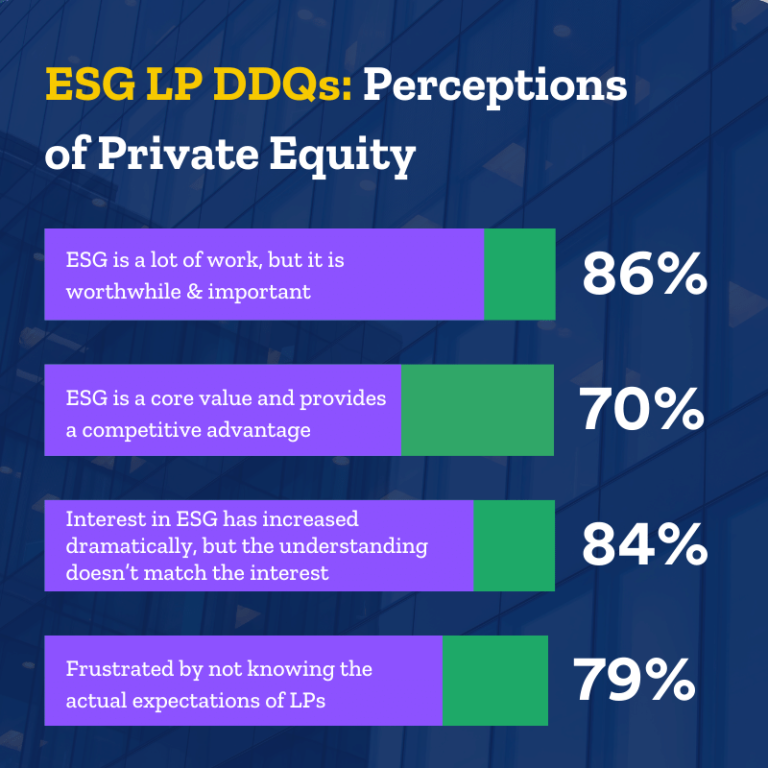
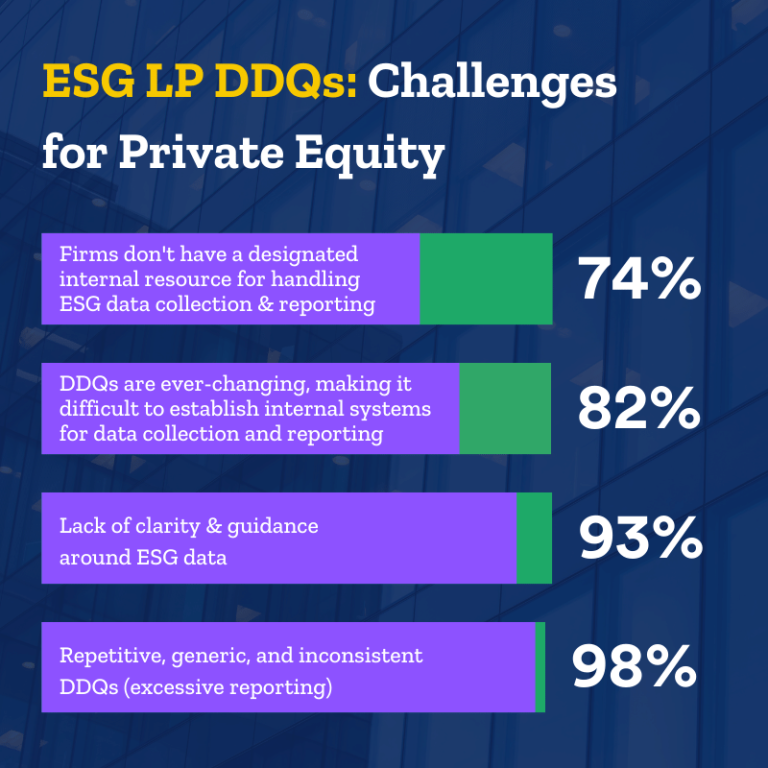
While a majority of General Partners (GPs) believe that ESG is a core value, 90% of them find investor Due Diligence Questionnaires (DDQs) to be excessive, repetitive, and inefficient. This frustration is exacerbated by the fact that 88% struggle to find effective ESG reporting solutions.

(source: Independent ESGTree survey)

Over the past two years, an overwhelming majority of General Partners (GPs) have increased efforts to manage and measure the ESG performance of their portfolio companies. Indeed, this trend has been examined in a 2022 Bains & Company and Institutional Limited Partners Association (ILPA) report, revealing that Limited Partner (LPs) no longer view ESG efforts as an exercise in good PR or risk mitigation, but rather as a compelling value creation tool. Yet, when it comes to meeting LP demand for greater ESG integration, GPs continue to report a lack of clarity and guidance around ESG data collection. Our report delves deeper into this conundrum by highlighting the pain points that GPs and LPs experience when it comes to LP due diligence and exploring the possible solution to these existing challenges.

The GP Sentiment – A Triad of Challenges

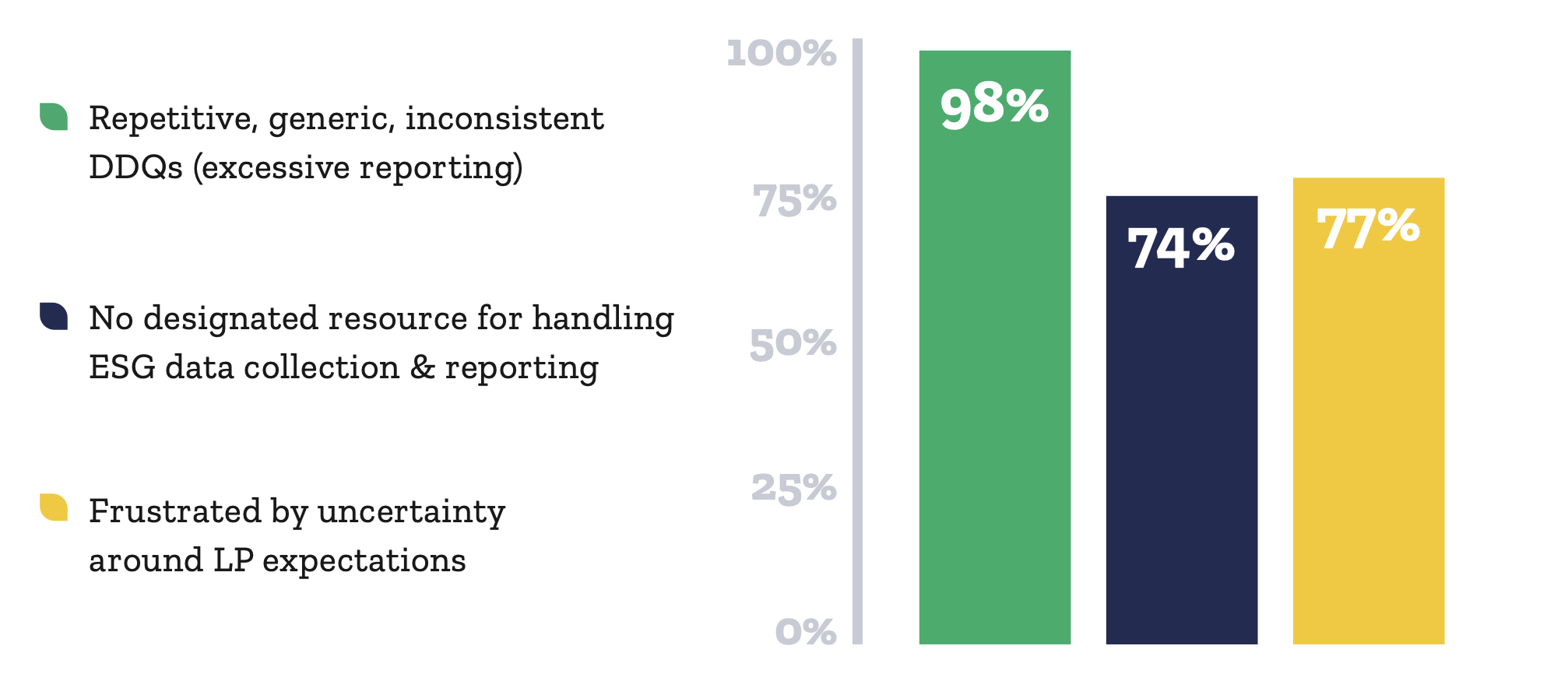
Our extensive interviews with GPs from some of the biggest private equity firms revealed a triad of challenges that GPs experience when it comes to LP due diligence. While 80% of the interviewed GPs appreciate the purpose and significance of ESG, almost all of them 1) remain unsure about the value of the “excessive” DDQs, 2) report a lack of clarity and guidance around ESG data, and 3) lack a designated internal resource for handling ESG data collection and reporting.

The root cause of most of the challenges around LP due diligence is that LPs themselves are still trying to work out what they are looking for and why it is important to them. 77% of the GPs that ESGTree interviewed reported being discouraged by this uncertainty among LPs, making it a key contributor to the GP consensus that there is a lack of clarity and guidance around ESG data reporting. Despite the numerous frameworks and initiatives to standardize ESG data collection in the private equity sphere, the tug-of-war between GPs and LPs remains far from resolved.

The GP-LP Sentiment – Data Overload

The GPs we interviewed also discussed the problem of data overload, which can be frustrating for both GPs and LPs alike. Collecting and processing ESG data all at once is overwhelming, tedious, complex and unrealistic for GPs and their portfolio companies. The situation is exacerbated by the fact that most GPs (74%) do not have designated internal resources for handling ESG data collection and reporting, and “are all stretched so thin” (as one ESG head told us). At the same time, LPs don’t want to receive raw portfolio company data that they might struggle to analyse and interpret; they prefer information in a more digestible format.

GPs feel that tech-enabled service providers like ESGTree are providing immense value by delivering flexible solutions that can:

  • Standardize the taxonomy of ESG
  • Provide independent ESG assessments and benchmarks
  • Offer GPs flexibility in adhering to different standards that are constantly changing

Every single GP that we interviewed admitted that if they had a centralized platform to house all the DDQs, it would help them give better-quality answers. This in turn would drive sounder ESG policies beyond basic box ticking, boosting overall LP portfolio performance. On the other hand, a lack of attention to ESG can jeopardize proposed deals, the Bains & Company report adds.

In order to reap the benefits of ESG, however, management teams need to come on board. Rather than silo ESG within risk management teams, an organizational shift is required where ESG is embedded into every level of an organization, starting at the top. Fortunately, firms are starting to recognize this: a recent KPMG survey found that 73% of organizations felt that the CFO was critical to leading ESG strategy, highlighting a growing awareness that ESG risk and financial risk are intertwined.

Opportunely, our proprietary software not only bridges the gaps experienced by GPs through DDQ automation, but its in-built collaboration tools allow for easy access to synthesized data across departments to drive the necessary organizational shifts to harness the power of ESG.

Why ESGTree:

Our platform is purpose-built for private equity investors and offers automated data collection requests with auto-reminder notifications, ready-to-implement framework automations, ESG advisory services, and other customizable features.

Our Client Success Team is comprised of veteran experts in ESG, technology and impact investing, who advise our clients on their ESG strategy. Currently, there is a large skill gap in the market and most providers lack trained ESG specialists to keep up with evolving ESG requirements and regulations.

Our unique ESG scorecards, benchmarking tool, and carbon calculation software serve a diverse set of private equity firms.

We position ESG as a value-creation exercise rather than a reporting burden.

ESGTree Features:

  • Automated data collection with portfolio-level access & aggregation capabilities
  • Company-specific ESG scorecards to provide value creation for portfolio companies
  • Simplified greenhouse gas emissions calculator
  • Multi-level trends analysis and visualizations by indicator, framework, and reporting periods
  • Client success support from ESG experts
  • Ready-to-implement framework automation including SASB, IRIS+, TCFD, EDCI, PCAF, SFDR and DEI.
  • Industry benchmarking against a dataset of 10,000+ companies
  • Purpose-built to streamline ESG reporting and collaboration for Limited Partners (LPs), General Partners (GPs) and portfolio companies.

A Brighter Future for ESG Reporting & LP Due Diligence

Despite the challenges of LP due diligence, GPs are faced with an immense opportunity to create value from ESG adoption. Firms that choose not to prioritize robust and integrated ESG strategies and reporting mechanisms may hurt their fundraising capacity and fall behind in an investment environment where ESG is now a mainstream consideration. Fortunately, it appears that the private funds industry is moving towards a greater understanding of GP reporting requirements and an improved interpretation of ESG regulatory disclosure rules. Above all, all GPs agreed that consolidated ESG standards across all working groups would be invaluable, along with regular, constructive dialogue between GPs and LPs on what is achievable. Ideally, LP due diligence must go beyond regulatory requirements and become more effective at defining, measuring, evaluating and communicating ESG impacts, to the benefit of all participants.

Our Clients

We work with a range of financial institutions such as Impact Investors, Private Equity (PE) and Venture Capital (VC), Pension Funds, Development Finance Institutions (DFIs), Banks, Companies & more.

ESGTree is great at helping to bring management teams on the same page. We view the ESGTree system and team as more of an extension of our company rather than a Software provider.

Director, Investor Relationships at ICV Partners

ESGTree streamlines our ESG reporting to our investors. Most notably, the Carbon Calculator feature, which reduces the time taken to calculate carbon emissions by 70%. Kudos to the ESGTree team for providing such a seamless user experience. Senior Market Analyst at Emburse

ESGTree provides powerful data solutions to help private equity (PE) and venture capital (VC) firms gather, collect, analyze, benchmark and report their ESG data and that of their portfolio companies. Our carbon calculator, customizable and automated ESG frameworks, multi-level report viewing, trends analysis dashboard, and other features aimed to make ESG a value creation tool rather than a reporting burden.

Click here to learn more about our ESGTree’s ESG software solution for Private Equity & Venture Capital.

With ESGTree, save the time and cost of ESG reporting by harnessing the power of the cloud and streamlining ESG data collection, analysis and disclosure.  

For more information on the ESGTree’s ESG Reporting Solution, please contact us at :

[email protected]

or

Click here to book a demo.

Contact Us

Email

Office Addresses

Canada: ESGTree, CPA 4th Floor, 140 West mount Rd N, Waterloo,
ON N2L 3G6, Canada

United Kingdom: ESGTree, 33 Queen Street, London EC4R 1AP, United Kingdom

Categories
ESGTREE

How Can Private Equity Position Itself for the US SEC’s Climate Disclosure Rules?

How Can Private Equity Position Itself for the US SEC’s Climate Disclosure Rules?

Share:

Table of Contents

On March 6th 2024, the United States Securities and Exchange Commission (SEC) released its highly anticipated climate-related disclosure rules for public US companies.

Originally published in March 2022, the SEC proposed that all publicly listed US companies be mandated to report their climate data in alignment with reporting recommendations from the Taskforce on Climate-related Financial Disclosures (TCFD).

When the proposal was then opened for public comment, the SEC received over 3,400 letters, significantly more than it customarily does when seeking public input.

While the SEC ruling applies to public companies, given the current global regulatory environment and calls for greater scrutiny of ESG claims within the private equity industry, it is only a matter of time before similar climate considerations be asked of private funds. Moreover, although the proposal will almost certainly face some measure of legal challenges, this will likely not deter 98% of companies from implementing climate reporting, according to a PricewaterhouseCoopers survey of 300 senior executives at US public companies with at least $500 million in revenues.

A deeper look at the SEC Proposal

The SEC’s final climate disclosure rule (i.e. the Final Rule) aims to provide investors with consistent and comparable information with which to examine the sustainability and climate risk profile of potential investments. It is also wide-ranging, covering the disclosure of greenhouse gas (GHG) emissions, predicted climate risks, and sustainability transition plans. Some if its main disclosure provisions include:

  • Scope 1 and 2 GHG emissions by large Accelerated Filers (LAFs) & Accelerated Filers (AFs) on a phased-in basis, accompanies by an attestation report. 
  • Potential risks to and material impacts on an organization resulting from climate change, aligned with TCFD disclosure recommendations
  • Quantitative and qualitative financial impacts of climate-related events such as severe weather events
  • Governance and risk management-related information including scenario analyses, physical risks, transition risks, transition plans and other climate-related programs such as the use of carbon offsets or internal carbon pricing

Companies have a phased-in period to comply with the Final Rule, and the deadline depends on: 1) their filing status (i.e. whether they are an LAF, AF, a Non-Accelerated Filer (NAF),  Smaller Reporting Company (SRC), or an Emerging Growth Company (EGC)) and 2) the content of their disclosure. In general, LAFs have the shortest time window to comply with the Rule, followed by AFs, and then SRCs, NAFs, and EGCs. 

The Final Rules will become effective 60 days after publication in the Federal Register.

An opportunity for private equity?

Though the SEC proposal applies to public markets, there are three potential avenues for direct overlap with private markets:

  • Publicly traded private equity firms: Private equity firms traded on the stock market, along with their portfolio companies, would be subject to SEC rules
  • Private equity portfolio companies going public: When making an Initial Public Offering (IPO), SEC-mandated climate information would need to be disclosed
  • Private equity firms that are Registered Investment Advisors (RIAs): If adopted, the Proposed Rules would be the first time that the SEC has required disclosure of a specific aspect of the investment process by Registered Investment Advisors (RIAs).

Critically, in contrast to public markets, private equity and venture capital markets have direct responsibility for the companies or start-ups they invest in, often holding board seats in these companies. This direct-stakes approach to raising capital, along with the responsibility to their own board members who typically have considerable wealth at risk, means private capital firms will be held to a far higher standard of accountability as ESG regulation continues to tighten worldwide. Venture capital firms, in particular, have an opportunity to integrate ESG into their portfolio companies from the get-go during the early stage of a company’s life cycle.

How can private equity prepare for the SEC’s disclosure rules?

Given the unique nature of private equity to position itself as an ESG leader, the following areas may be considered when formulating a climate accounting strategy:

  • Begin with a baseline collection of solid, reliable and verifiable data before crafting strategies and policies. Data is the edifice upon which ESG strategy rests.
  • Embed ESG considerations into all stages of the investment lifecycle, from pre-deal assessments to exit plans
  • Conduct a gap analysis by reviewing all current disclosure policies
  • Conduct an audit of all greenhouse gas emissions related to portfolio companies
  • Consider greenhouse gas emissions resulting from the supply chain: prioritize those suppliers with strong ESG credentials
  • Leverage technology solutions to streamline and automate ESG reporting

If you are a Private Equity firm that is also an RIA, further planning and consideration may be required when formulating your climate accounting strategy since an additional specific set of disclosure requirements will apply. In this case, you can prepare for the upcoming SEC disclosure mandate by: 

  • Determining the applicable fund category: Whether and how the SEC’s Proposed Rules will impact an RIA depends primarily on which of the 3 ESG fund types (i.e. “ESG Integration,” “ESG-Focused,” and “ESG Impact”) apply to the RIA’s investment decisions.
  • Tailoring your marketing and advertising policies to the new ESG fund-type classification system: RIAs should be deliberate about the publication of marketing & sales collaterals that indicate the significance of ESG factors in investment decision-making, as this could unintentionally lead to enhanced disclosure obligations
  • Creating consistent internal policies regarding the use of ESG metrics: seeing how a key focus of SEC’s Proposed Rules for RIAs is the consistency of disclosures in their prospectuses, annual reports and brochures.

Technology: the missing piece

Technology will play a paramount role in successful ESG compliance – a belief echoed by a majority of business leaders.

Keeping the needs of private capital investors in mind, ESGTree has developed several climate reporting tools to collect, analyze, and automate this data and simplify reporting.

These include:

  • An automated TCFD reporting tool: ESGTree’s cloud-based software boils down the reporting process to 40 simple multiple-choice questions that, upon completion, automatically generate the TCFD report.
  • An automated Partnership for Carbon Accounting Financials (PCAF) tool: Automating this framework allows organizations to calculate their financed emissions i.e. emissions associated with their loans and investments
  • Carbon Calculator: ESGTree’s Carbon Calculator allows staff members themselves to generate Scope 1, 2 and 3 GHG emissions using basic information about company operations. Our clients have reported a 70% reduction in the time it takes to calculate this information.

The SEC’s climate disclosure rules do not exist in a vacuum. As more regulators across the world toughen ESG rules, consolidate standards and crack down on greenwashing, the private equity industry is well-placed to lead the transition to a more sustainable, low-carbon economy.

For more information on the Final U.S. Securities and Exchange Commission (SEC) Climate Disclosure Rules, click here to download the official SEC Rules Document. 

ESGTree provides powerful cloud-based data solutions to help private equity (PE) and venture capital (VC) firms gather, collect, analyze, benchmark and report their ESG data and that of their portfolio companies. Our carbon calculator, customizable and automated ESG frameworks, multi-level report viewing, trends analysis dashboard, and other features turn ESG into a value creation tool rather than a reporting burden.

Click here to learn more about ESGTree’s data management and reporting software for private capital investors. 

Who Should the Economy Really Serve?

Who Should the Economy Really Serve?

The rallying cry of the American Revolution – no taxation without representation – is today taken as self-evident but deserves a re-examination in light of the climate crisis and sustainable…

Summary

Share:

What is the US SEC climate disclosure proposal?

Why should private equity care about the SEC climate proposal?

How can private equity prepare for the SEC’s disclosure rules?

How can technology be leveraged to report climate data?

Contact Us

Contact Us

Email

Office Addresses

Canada: ESGTree, CPA 4th Floor, 140 West mount Rd N, Waterloo,
ON N2L 3G6, Canada

United Kingdom: ESGTree, 33 Queen Street, London EC4R 1AP, United Kingdom

Categories
ESGTREE

The Regulatory Rise of TCFD Reporting

The Regulatory Rise of TCFD Reporting

Share:

Table of Contents

The Taskforce on Climate-related Financial Disclosures (TCFD) has arguably become the dominant framework for reporting climate data, as evidenced by a number of recent regulatory moves:

The Rise Of TCFD Reporting

  • The United Kingdom now mandates TCFD-aligned reporting requirements for the private sector. 
  • The United States Securities and Exchange Commission (SEC) requires publicly traded US companies to disclose climate data based on TCFD recommendations. 
  • Beginning in 2024, all federally regulated financial institutions in Canada will have to report climate data in line with TCFD.  
  • The governments of Brazil, the European Union, Hong Kong, Japan, New Zealand, Singapore and Switzerland have announced requirements for climate disclosures informed by TCFD recommendations to be implemented by various timelines. 

What exactly is TCFD?

The TCFD framework is the brainchild of the Financial Stability Board (FSB), the Switzerland-based international body that makes recommendations on the global financial system. Released in 2017, its recommendations aim to help companies release meaningful climate data as the world attempts to transition to a low-carbon economy. 

The taskforce itself is chaired by Michael Bloomberg (founder of Bloomberg LP and former mayor of New York City) and consists of 31 members from across the G20 countries, including executives from Unilever, BNP Paribas, JPMorgan Chase, and BlackRock among others. 

TCFD boasts over 2,000 supporters across the globe, in the form of governments, financial institutions and the private sector. The 1,069 financial institutions that have so far openly supported TCFD together represent USD$194 trillion in assets under management. 

The Four Pillars of TCFD

The framework itself consists of 11 disclosure recommendations spanning four interrelated thematic areas: governance, strategy, risk management, and metrics and targets. With the exception of the last area, these recommendations are largely qualitative in nature, and can be summarized as follows: 

Governance: companies should disclose their management and board’s strategy for monitoring and assessing climate risk (and opportunity). 

Strategy:  companies should identify climate risks and opportunities foreseen over the short, medium and long term; explain the impact of these risks and opportunities on their planning and operations; and assess how resilient their strategy is in various climate-related scenarios (i.e., climate stress tests). 

Risk Management:  companies should explain their process for identifying and managing climate risk and how this process fits into the overall picture of risk management. 

Metrics and Targets: companies should disclose the specific metrics used to inform their climate strategies, including the disclosure of scope 1, 2, and 3 greenhouse gas emissions among other conventional metrics. They should also disclose climate goals or targets and their progress towards them. 

Challenges and Solutions to Implementing TCFD for Private Equity

Although the TCFD report is short and largely qualitative, it nevertheless poses an additional burden to organizations that, at present, face different ESG reporting requirements from their investors with little support or direction on how to implement them. 

Given its relative newness, gathering and comparing climate data remains a major challenge for organizations. The larger the portfolio is, the more difficult it is to capture this data. And given that even large organizations struggle with this, small and medium-sized enterprises have even fewer resources to tackle data collection and analysis. Take, for example, calculating Scope 3 greenhouse gas emissions – i.e. emissions resulting from a company’s supply chain – which are out of the direct control of a company. 

Collecting information on climate risk is also complex because the data is not isolated, but rather a part of an interconnected system. While companies already have a handle on more traditional financial risk, with a standard set of operating procedures, it is not enough to tackle climate data in an isolated fashion. This is why, as part of ESGTree’s TCFD automation tool, we often recommend involvement at the Board level on climate strategy. 

ESGTree's TCFD Tool for Private Equity

To simplify the TCFD reporting process, ESGTree’s cloud-based software boils down the reporting process to 40 simple multiple-choice questions that, upon completion, automatically generate the TCFD report, thereby automating much of the difficult legwork. Based on the responses to the questions, ESGTree is able to provide recommendations and action items on how to improve a company’s climate performance vis-a-vis the four pillars of the framework. 

This is complemented by ESGTree’s automated Carbon Calculator which allows for seamless calculation of carbon emissions by taking in data that companies easily have on hand and providing the figures for 1, 2, and 3 emissions immediately.  

Given the legislative action and international buy-in of TCFD, it is advisable to add TCFD to your climate action plan now rather than later in order to stay ahead of the regulatory curve and minimize transition risk as the world moves towards a lower carbon economy. 

ESGTree’s automated and customizable ESG frameworks help private market investors stay on top of the ESG performance of their portfolio companies. Private equity (PE) and venture capital (VC) firms and other financial institutions rely on ESGTree’s multi-layered platform to collect, analyze, benchmark and report ESG data hassle-free.

Who Should the Economy Really Serve?

Who Should the Economy Really Serve?

The rallying cry of the American Revolution – no taxation without representation – is today taken as self-evident but deserves a re-examination in light of the climate crisis and sustainable…

Summary

Share:

What is TCFD?

Where has TCFD been regulated?

How is TCFD structured?

How can TCFD be implemented?

Categories
updateresources

Decoding Climate Disclosures for Financial Institutions 2024

Decoding Climate Disclosures for Financial Institutions 2024

Share:

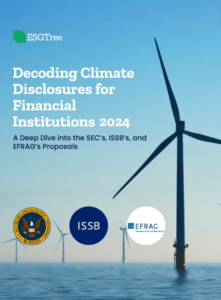
Understanding climate risks and opportunities is paramount for investors, regulators, and economies striving towards sustainable business models and net-zero futures. With climate risk now being recognized as a critical financial risk, stakeholders have no choice but to prioritize compliance with Climate Disclosures, which can be difficult to navigate & understand. 

To stay ahead of the game, we have published a comprehensive guide that decode’s climate disclosures for financial institutions:

Decoding Climate Disclosures for Financial Institutions 2024 (The SEC’s, ISSB’s, and EFRAG)

 In this guide, we break down and simplify the much-anticipated climate reporting rules by the US Securities and Exchange Commission (SEC), the International Sustainability Standards Board (ISSB) and the European Financial Reporting Advisory Group (EFRAG).

Who Should the Economy Really Serve?

Who Should the Economy Really Serve?

The rallying cry of the American Revolution – no taxation without representation – is today taken as self-evident but deserves a re-examination in light of the climate crisis and sustainable…

Contact Us

Contact Us

Email

Office Addresses

Canada: ESGTree, CPA 4th Floor, 140 West mount Rd N, Waterloo,
ON N2L 3G6, Canada

United Kingdom: ESGTree, 33 Queen Street, London EC4R 1AP, United Kingdom

Categories
updateresources

Drowning in DDQs – Tanya Carmichael / ESGTree Podcast Interview

Drowning in DDQs - Tanya Carmichael / ESGTree Podcast Interview

Share:

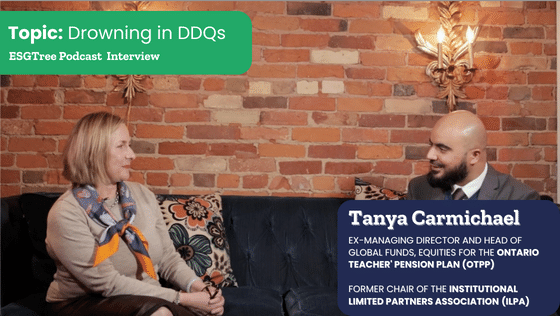
We had an insightful conversation with Tanya Carmichael, ESGTree’s Advisory Board Member, ex-Head of Global Funds Private Capital at Ontario Teacher’s Pension Plan (OTPP) and ex-Chair of the Institutional Limited Partners Association (ILPA). In our candid talk below, Tanya shares her thoughts about ESG integration, reporting and how LPs can prevent GPs from drowning in due diligence questionnaires (DDQs).

According to PwC and Harvard, 81% of institutional investors in the US plan to increase their allocations to ESG products over the next two years, almost on par with Europe (83.6%).

This would effectively more than double the ESG AUM in the US, over a five year period, from US$4.5 trillion in 2021 to US$10.5 trillion in 2026. This is forecasted despite the complexities of administrations changes and some state governments continuing to push back on ESG (https://corpgov.law.harvard.edu/2022/11/17/exponential-expectations-for-esg/)

So how can the friction between institutional investors (limited partners) and private equity firms (general partners) be reduced, while leveraging technology solutions to improve efficiency and reduce cost?

Tanya answers this question from her long-standing role as both investor and convener, offering a unique perspective on this prevalent problem. 

ESGTree's Report on Limited Partner (LP) Due Diligence Questionnaires (DDQs)

We interviewed General Partners (GPs) from several private equity firms & published a Report on the challenges they experience with LP DDQs. Opportunely, our proprietary software not only bridges the gaps that GPs experience, but its in-built collaboration tools allow for easy access to synthesized data across departments to drive the necessary organizational shifts to harness the power of ESG.

Click here to learn more


About ESGTree:

ESGTree provides powerful cloud-based data solutions to help private equity (PE) and venture capital (VC) firms gather, collect, analyze, benchmark and report their ESG data and that of their portfolio companies. Our carbon calculator, customizable and automated ESG frameworks, multi-level report viewing, trends analysis dashboard, and other features turn ESG into a value creation tool rather than a reporting burden.

Click here to learn more about ESGTree’s data management and reporting software for private capital investors. 

Who Should the Economy Really Serve?

Who Should the Economy Really Serve?

The rallying cry of the American Revolution – no taxation without representation – is today taken as self-evident but deserves a re-examination in light of the climate crisis and sustainable…

Contact Us

Contact Us

Email

Office Addresses

Canada: ESGTree, CPA 4th Floor, 140 West mount Rd N, Waterloo,
ON N2L 3G6, Canada

United Kingdom: ESGTree, 33 Queen Street, London EC4R 1AP, United Kingdom

Categories
updateresources

ESGTree Collaborates with the EDCI on Inbound Data Submission

ESGTree Collaborates with the EDCI on Inbound Data Submission

Share:

ESGTree – one of the first platforms globally to automate EDCI data submission – is now collaborating with the ESG Data Convergence Initiative (EDCI) on inbound data submission. By integrating directly with the EDCI data portal, ESGTree can further streamline data submission & validation to the EDCI for ESGTree clients.

The ESGTree Solution: From a Burden to Opportunity

Private equity has turned a corner on responsible investment with the help of the EDCI, which boasts a global membership of 350+ Limited Partners and General Partners that are collaborating with various stakeholders to drive convergence around ESG metrics. The aim is to generate a critical mass of comparable information on how GPs’ portfolio companies are performing on ESG relative to each other, as well as to promote greater reporting transparency for limited partners (LPs).

The EDCI is collaborating with ESGTree in this endeavour, where both parties are committed to propagating the adoption of a standard set of metrics across the investment sector.

Thanks to this collaboration, ESGTree clients can directly submit their reports to the EDCI by using the ESGTree platform. They can also:

–   Easily calculate scope 1, 2 and 3 emissions for their portfolio companies with ESGTree’s proprietary Carbon Calculator.

–   Build internal capacity with step-by-step guidance on how to report on EDCI metrics via our Client Success Team.

Shahzeb Irshad, Senior Vice President of Operations at ESGTree, affirmed,

“Our collaboration with EDCI highlights our commitment to solve for the lack of standardized ESG metrics.”

A Holistic Approach to ESG Reporting Beyond the EDCI

ESGTree offers financial institutions – including private equity firms and banks – a comprehensive Suite of Solutions to efficiently manage their ESG Data. Beyond the EDCI, the ESGTree platform boasts customizable ESG Frameworks, trends analysis, automated data management, and detailed dashboards, making it a singular, unified platform for ESG Reporting.

“Our General Partners clients are consistently rated in the top 10% by their Limited Partners for ESG performance.” Says Shahzeb Irshad – Senior Vice President of Operations at ESGTree

With ESGTree, financial institutions can leverage the power of cloud computing and advanced data solutions to not just comply with but excel under various regulations, spearheading the movement towards a more sustainable financial ecosystem.

For more information on how ESGTree is redefining compliance and ESG disclosures, reach out at [email protected] or book a demo today.

About ESGTree:

ESGTree serves as your all-encompassing ESG data partner, offering a comprehensive solution for collecting, analyzing, and reporting ESG data. Our cloud-based platform is meticulously tailored to address the specific requirements of private capital investors, providing customizable metrics and user-friendly experiences.

We collaborate with a diverse array of financial institutions, including impact investors, private equity and venture capital firms, pension funds, development finance institutions, and banks.

Contact us today at [email protected] to explore how ESGTree can elevate your ESG reporting endeavors and bring value to your portfolio companies.

ESGTree provides powerful cloud-based data solutions to help private equity (PE) and venture capital (VC) firms gather, collect, analyze, benchmark and report their ESG data and that of their portfolio companies. Our carbon calculator, customizable and automated ESG frameworks, multi-level report viewing, trends analysis dashboard, and other features turn ESG into a value creation tool rather than a reporting burden.

Click here to learn more about ESGTree’s data management and reporting software for private capital investors. 

Who Should the Economy Really Serve?

Who Should the Economy Really Serve?

The rallying cry of the American Revolution – no taxation without representation – is today taken as self-evident but deserves a re-examination in light of the climate crisis and sustainable…

Contact Us

Contact Us

Email

Office Addresses

Canada: ESGTree, CPA 4th Floor, 140 West mount Rd N, Waterloo,
ON N2L 3G6, Canada

United Kingdom: ESGTree, 33 Queen Street, London EC4R 1AP, United Kingdom

Categories
updateresources

A Private Equity Firm’s Journey Taking ESG from Reporting Burden to Value Creation

A Private Equity Firm’s Journey Taking ESG from Reporting Burden to Value Creation

Share:

A leading private equity firm partnered with ESGTree to streamline its ESG reporting journey for its portfolio companies while creating value for them in the process

After pressure from investors and regulators to report on ESG, a leading private equity firm chose the ESGTree technology platform to automate its ESG data management and analysis while leveraging ESGTree’s Advisory team for policy creation, annual ESG reporting and capacity-building activities. The firm knew it needed to partner with a leading SaaS company with deep expertise in ESG for private markets, both on the technology and consulting fronts.

Lead-up to the ESGTree Partnership:

In 2019, the firm decided that becoming a best-in-class ESG investor was a top priority. It had consistently set the bar for investment excellence and was committed to understanding the ESG impact of its operations and its vast portfolio companies. This, coupled with the surge in demand for ESG data from investors and oncoming regulation, pushed the firm to take matters into its own hands.

The firm struggled with large spreads of decentralized data from several portfolio companies, complex calculations on multiple data points, and a knowledge gap on standards and compliance-related issues. Collecting and processing ESG data manually in Excel sheets was overwhelming, tedious, complex and expensive.

Leveraging Tech-enabled and Investor-Grade Reporting with ESGTree:

The private equity firm quickly realized that it needed an ESG data management and reporting solution to collect, organize, and report its ESG data.

When its leadership team met ESGTree, it was the first time they had encountered a technology solution purpose-built for private capital investors which also provided essential advisory services to chalk out the ESG roadmap, strategy and vision.

Moreover, the platform offered carbon calculation tools, ESG data collection and reporting, independent ESG scorecards for portfolio companies, a benchmark analysis tool backed by large ESG datasets, and trends analysis, all at the firm and portfolio level. Impressed by the Suite of capabilities, the firm decided to partner with ESGTree.

Moving From Reporting Burden to Value Creation:

ESGTree’s Client Success Team trained and aligned the firm’s senior leadership on ESG best practices, and automated metrics based on materiality principles, enabling the firm to conduct in-depth materiality analysis and peer benchmarking against an inbuilt dataset of over 10,000 companies.

ESGTree’s built-in reporting questionnaires, auto reminder notifications, leaderboards, and proprietary scorecards allowed portfolio companies to seamlessly track and optimize their ESG scores based on data-driven insights, allowing the firm to gain visibility of the ESG health of its entire portfolio.

By applying ESG best practices from top-performing portfolio companies to the ones that were lagging behind, the firm was able to develop a true value-creation system.  In addition, portfolio companies started using the Scorecards and Carbon Calculator to fill out other, non-investor ESG due diligence forms as well — benefiting their business overall.

ESGTree: A One-Stop Solution – Technology + Advisory Services:

With a strong belief in the capabilities of the ESGTree technology platform, the firm decided to employ the full suite of ESGTree’s Advisory Services. ESGTree then worked alongside the newly formed ESG Committee to structure the firm’s ESG approach from the ground up, including activities such as:

  • Creating the firm’s ESG and climate policies
  • Generating Quarterly ESG Reports for the firm’s Limited Partners (LPs)
  • Drafting the firm’s Annual ESG Report, including creative design and publication
  • Leading webinars, conferences, and presentations for training and capacity-building amongst the firm’s executive teams, employees and portfolio companies.

Book A Demo: Start your ESG Journey Today!

With ESGTree, you can save the time and cost of ESG reporting by harnessing the power of the cloud and streamlining ESG data collection, analysis and disclosure.  If you’re ready to start your ESG Reporting Journey, or want to learn more, contact us at: [email protected]

Our Clients

We work with a range of financial institutions such as Impact Investors, Private Equity (PE) and Venture Capital (VC), Pension Funds, Development Finance Institutions (DFIs), Banks, Companies & more.

We collect a lot of data on our companies, but this is data we do not have anywhere else. We benchmark everything, so I’m not sure why we didn’t think of benchmarking ESG data before ESGTree.

~ Managing Partner, Private Equity Client 

ESGTree provides powerful data solutions to help private equity (PE) and venture capital (VC) firms gather, collect, analyze, benchmark and report their ESG data and that of their portfolio companies. Our carbon calculator, customizable and automated ESG frameworks, multi-level report viewing, trends analysis dashboard, and other features aimed to make ESG a value creation tool rather than a reporting burden.

Click here to learn more about our ESGTree’s ESG software solution for Private Equity & Venture Capital.

With ESGTree, save the time and cost of ESG reporting by harnessing the power of the cloud and streamlining ESG data collection, analysis and disclosure.  

For more information on the ESGTree’s ESG Reporting Solution, please contact us at :

[email protected]

or

Click here to book a demo.

ESG Is Here to Stay!

ESG Is Here to Stay!

By 2025, ESG assets are estimated to exceed USD$50 trillion. In other words, one third of Assets Under Management (AUM) will be classified as ESG assets in the next three…

Contact Us

Email

Office Addresses

Canada: ESGTree, CPA 4th Floor, 140 West mount Rd N, Waterloo,
ON N2L 3G6, Canada

United Kingdom: ESGTree, 33 Queen Street, London EC4R 1AP, United Kingdom

Categories
updateresources

A Private Equity Firm’s journey with ESGTree to improve Social Factors and Impact

A Private Equity Firm’s Journey with ESGTree to Improve Social Factors and Impact

Share:

Since 2020, ESGTree has been working with a $10BN+ Private Equity (PE) firm, based in the United States, to streamline and report on their Environmental, Social and Governance (ESG) initiatives, with a focus on DE&I and BIPOC best-in-class practices. Key themes across which ESGTree has helped the PE firm are:

  • Impact management
  • Diversity, equality, and inclusion
  • Additionality and intentionality
  • Minority issues, vulnerable groups, Black, Indigenous, and People of Colour (BIPOC)

Impact Management

We helped our client refine their impact goal to have more women in leadership positions. As a result, active steps were taken to increase the representation of women at the board level, in executive management, non-executive management, and among employees. Today, several of our clients’ portfolio companies are led by women CEOs and, in 2021, more than 50% of their new hires were women. Internally, women and individuals from ethnic backgrounds now comprise over 60% of the firm, elucidating the value our team was able to create for the firm.

Diversity, Equality, and Inclusion (DE&I)

We took a triangular approach to DE&I with this client by using data to monitor various programs for gender, race, and marginalized groups. Our monitoring and reporting framework helped the client manage:

  • Gender, through various activities including, but not limited to, summer programs for coding for girls in grades 10-12, providing them with the opportunity to learn computer science
  • Racial minority representation and empowerment through a data-centric approach, focusing on alignment with the Institutional Limited Partners Association (ILPA) Diversity In Action (DIA) initiative and drawing out percentages to create action plans
  • Marginalized groups by tracking philanthropy and working with non-profit organizations to offer internships for young people coming from historically marginalized communities

Additionality and Intentionality

Our work with this PE firm was also centred around being intentional about the change they wanted to create. Our monitoring framework allowed the PE firm to track intention to develop students from “non-elite” universities as an impactful way to foster social mobility in the country. Today, more than a quarter of their current employees are first-generation college students, and less than 10% of their employees hold an undergraduate or graduate degree from an “elite” educational institution

Minority issues, vulnerable groups, Black, Indigenous, and People of Color (BIPOC)

Our ESG framework for this client identified the advancement of social mobility as an important driver for the firm along with efforts to value people from every background. To this end, the firm now provides in-kind and monetary support to non-profit organizations combating social inequalities and injustices and has partnered with a number of organizations focused on reducing social inequality.

ESGTree Reporting Software Features:

Our unique ESG scorecards, benchmarking tool, and carbon calculation software serve a diverse set of private equity firms. Thanks to the Platform Features below, we have been able to position ESG as a value-creation exercise rather than a reporting burden:

  • Automated data collection with portfolio-level access & aggregation capabilities
  • Company-specific ESG scorecards to provide value creation for portfolio companies
  • Simplified greenhouse gas emissions calculator
  • Multi-level trends analysis and visualizations by indicator, framework, and reporting periods
  • Client success support from ESG experts
  • Ready-to-implement framework automation including SASB, IRIS+, TCFD, EDCI, PCAF, SFDR and DEI.
  • Industry benchmarking against a dataset of 10,000+ companies
  • Purpose-built to streamline ESG reporting and collaboration for Limited Partners (LPs), General Partners (GPs) and portfolio companies.

Our Clients

We work with a range of financial institutions such as Impact Investors, Private Equity (PE) and Venture Capital (VC), Pension Funds, Development Finance Institutions (DFIs), Banks, Companies & more.

ESGTree is great at helping to bring management teams on the same page. We view the ESGTree system and team as more of an extension of our company rather than a Software provider.

Director, Investor Relationships at ICV Partners

ESGTree streamlines our ESG reporting to our investors. Most notably, the Carbon Calculator feature, which reduces the time taken to calculate carbon emissions by 70%. Kudos to the ESGTree team for providing such a seamless user experience.

Senior Market Analyst at Emburse

ESGTree provides powerful data solutions to help private equity (PE) and venture capital (VC) firms gather, collect, analyze, benchmark and report their ESG data and that of their portfolio companies. Our carbon calculator, customizable and automated ESG frameworks, multi-level report viewing, trends analysis dashboard, and other features aimed to make ESG a value creation tool rather than a reporting burden.

Click here to learn more about our ESGTree’s ESG software solution for Private Equity & Venture Capital.

With ESGTree, save the time and cost of ESG reporting by harnessing the power of the cloud and streamlining ESG data collection, analysis and disclosure.  

For more information on the ESGTree’s ESG Reporting Solution, please contact us at :

[email protected]

or

Click here to book a demo.

ESG Is Here to Stay!

ESG Is Here to Stay!

By 2025, ESG assets are estimated to exceed USD$50 trillion. In other words, one third of Assets Under Management (AUM) will be classified as ESG assets in the next three…

Contact Us

Email

Office Addresses

Canada: ESGTree, CPA 4th Floor, 140 West mount Rd N, Waterloo,
ON N2L 3G6, Canada

United Kingdom: ESGTree, 33 Queen Street, London EC4R 1AP, United Kingdom

Categories
updateresources

Guiding Financial Institutions on the Path to Net Zero

Guiding Financial Institutions on the Path to Net Zero

Share:

ESGTree is a cloud-based Environment, Social and Governance (ESG) data management and reporting platform for financial institutions. Our Carbon Calculator and automated climate reporting software are just some of the many features of our fully integrated platform. Our customizable technology, paired with industry-leading advisory services, provide our clients with the necessary tools to become leaders in the transition to net zero.

The Challenge For Financial Institutions

As ESG legislation tightens globally, financial firms are pushed to go beyond simply reviewing the greenhouse gas (GHG) emissions they generate. This means measuring, disclosing, and minimizing the emissions generated by portfolio companies, suppliers, properties and investments. Financial institutions will now have to contend with large spreads of data in an ever-evolving regulatory landscape.

ESGTrees’s 360° Carbon Footprint and Climate Disclosure Solution

ESGTree is purpose-built to solve these pressing challenges. Our globally recognised technology platform has enabled some of the largest businesses in the world to measure, manage, report, and minimize their environmental footprint across their value chain. Turn theory into practice with our proprietary Carbon Calculator and numerous automated ESG reporting frameworks, including:

  • Task Force on Climate-Related Financial Disclosures (TCFD)
  • Partnership for Carbon Accounting Financials (PCAF)
  • Sustainability Accounting Standards Board (SASB)
  • Sustainable Finance Disclosure Regulation (SFDR)
  • ESG Data Convergence Initiative (EDCI)

ESGTree Features

Multi-Level Data Governance

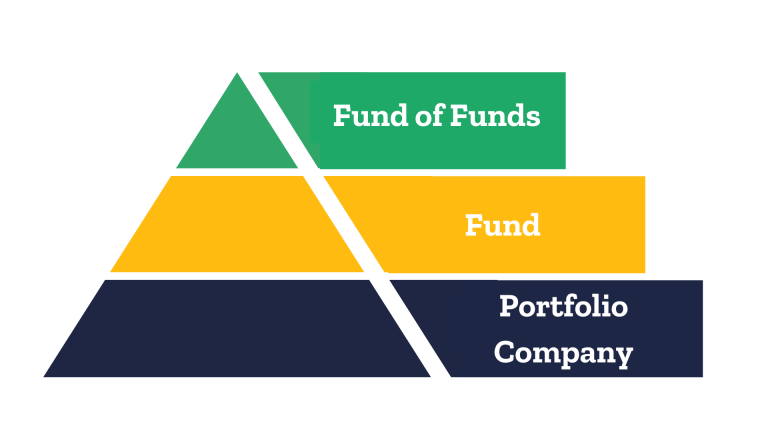
Our platform allows for data governance at three levels, so whether you’re a Fund of Funds, a Fund, or a Portfolio Company, you will have access to the dashboards and analytics that are relevant to you.

Map Carbon Emissions Across the Entire Value Chain

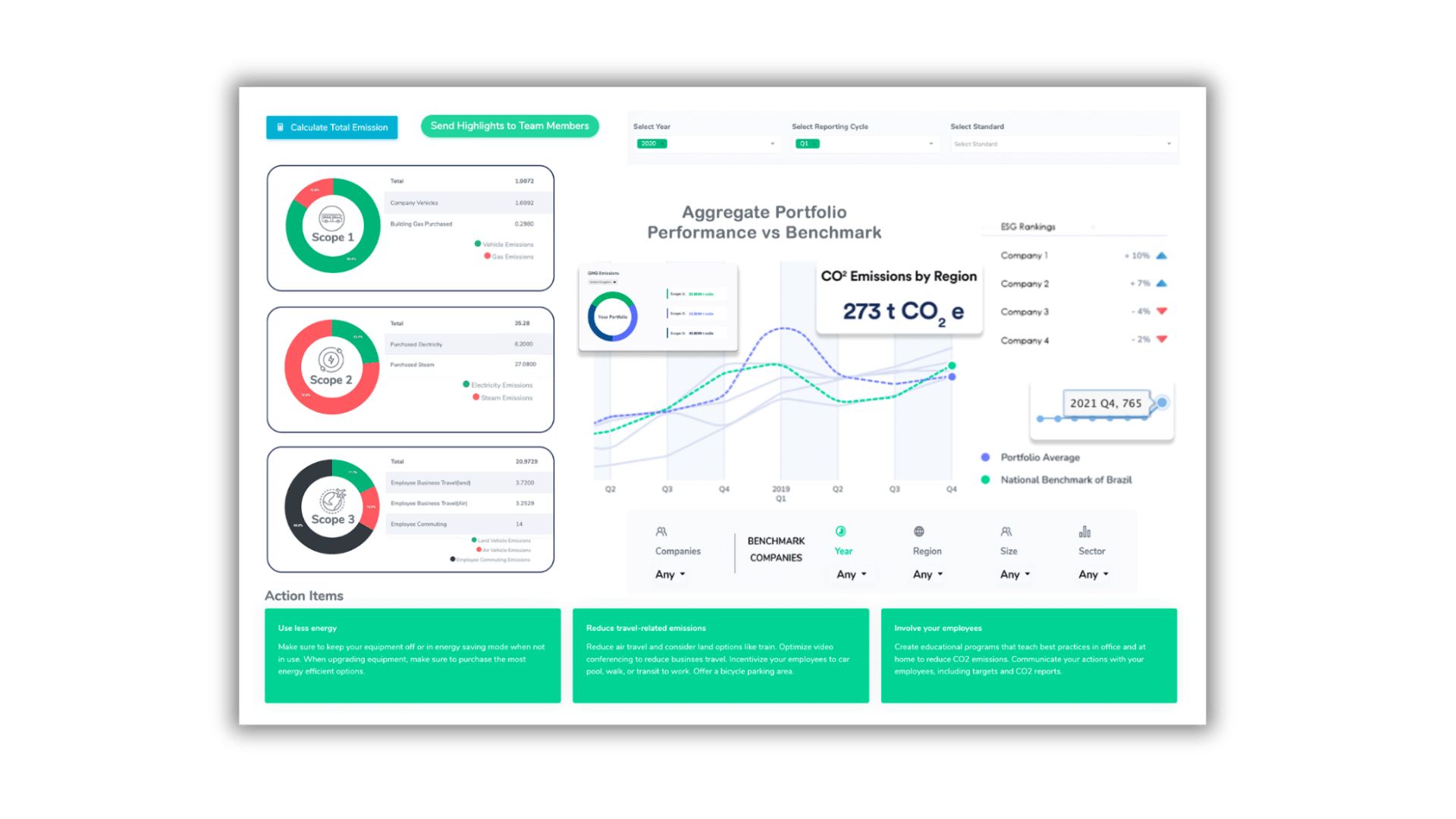
Our Carbon Calculator enables users to map out Scope 1, 2, and 3 GHG emissions for their firms and portfolio companies. Small and Medium sized-Enterprises (SMEs) especially appreciate our seamless Carbon Calculator as it reduces calculation time by 70%, making it a frontrunner in the market for carbon calculation. This, along with our built-in step-by-step reporting guides, collaboration tools, intelligent notifications and comprehensive industry benchmarks, transforms an ESG reporting burden into a value-creation endeavour across the entire value chain

Industry Leading Frameworks and Standards

In addition to our Carbon Calculator, our platform automates climate disclosure frameworks such as TCFD (Task Force on Climate-Related Financial Disclosure) and PCAF (Partnership for Carbon Accounting Financials). 

  • TCFD: allows organizations to understand and report on their climate-related risks and opportunities. Regulators worldwide are increasingly calling to mandate TCFD-aligned disclosures.
  • PCAF: enables financial institutions to standardize the collection, assessment and reporting of GHG emissions associated with their loans and investments

ESGTree is the only platform globally to have automated narrative TCFD report generation into a seamless process based on answering 40 multiple-choice questions. 

Chart the Path to Net Zero

With ESGTree, you save the time and cost of ESG reporting by harnessing the power of the cloud, streamlining ESG data collection, analysis and disclosure, and availing our Advisory Services to guide you every step of the way. 

 
Our Advisory Team is composed of veteran ESG, impact investing and technology experts who advise our customers strategically. By leveraging our technology and industry knowledge, our Team is able to:
  • Conduct comprehensive carbon footprint assessments
  • Develop our clients’ internal capacities
  • Identify emission reduction opportunities with our Net Zero Roadmaps, and
  • Determine the feasibility of implementing these opportunities

Our analytics dashboard then ensures measurable progress towards the client’s ESG goals.

Given the international buy-in and legislative action around TCFD, we strongly advise adding the TCFD framework to your climate action plan. By acting now, you can stay ahead of the regulatory curve and minimize transition risk as the world moves towards a lower carbon economy.

The ESGTree Difference

Understanding Data Challenges

Our clients range from large institutions with $200B+ in assets under management, to SMEs and impact investors. This diversity allows us to solve a wide range of data-related challenges, keeping us on the frontline of innovation in the industry.

ESGTree is great at helping to bring management teams on the same page. We view the ESGTree system and team as more of an extension of our company rather than a Software provider.

Director, Investor Relationships at ICV Partners

ESGTree Features:

  • Automated data collection with portfolio-level access & aggregation capabilities
  • Company-specific ESG scorecards to provide value creation for portfolio companies
  • Simplified greenhouse gas emissions calculator
  • Multi-level trends analysis and visualizations by indicator, framework, and reporting periods
  • Client success support from ESG experts
  • Ready-to-implement framework automation including SASB, IRIS+, TCFD, EDCI, PCAF, SFDR and DEI.
  • Industry benchmarking against a dataset of 10,000+ companies
  • Purpose-built to streamline ESG reporting and collaboration for Limited Partners (LPs), General Partners (GPs) and portfolio companies.

Our Clients

We have helped a number of financial institutions automate their ESG and carbon emissions data monitoring through our cloud-based system. Today, our system analyzes data for over 2,000 corporations on their way to Net Zero.

Reach out to us today at [email protected] to accelerate your journey to net zero.

ESGTree streamlines our ESG reporting to our investors. Most notably, the Carbon Calculator feature, which reduces the time taken to calculate carbon emissions by 70%. Kudos to the ESGTree team for providing such a seamless user experience. Senior Market Analyst at Emburse

ESGTree provides powerful data solutions to help private equity (PE) and venture capital (VC) firms gather, collect, analyze, benchmark and report their ESG data and that of their portfolio companies. Our carbon calculator, customizable and automated ESG frameworks, multi-level report viewing, trends analysis dashboard, and other features aimed to make ESG a value creation tool rather than a reporting burden.

Click here to learn more about our ESGTree’s ESG software solution for Private Equity & Venture Capital.

With ESGTree, save the time and cost of ESG reporting by harnessing the power of the cloud and streamlining ESG data collection, analysis and disclosure.  

For more information on the ESGTree’s ESG Reporting Solution, please contact us at :

[email protected]

or

Click here to book a demo.

Contact Us

Email

Office Addresses

Canada: ESGTree, CPA 4th Floor, 140 West mount Rd N, Waterloo,
ON N2L 3G6, Canada

United Kingdom: ESGTree, 33 Queen Street, London EC4R 1AP, United Kingdom

Categories
updateresources

Why ESGTree? – Differences that Make a Difference

Why ESGTree? - Differences that Make a Difference

Share:

The Triad that Differentiates ESGTree from Competitors

Over the past four years, one of the most common questions we get is: What differentiates ESGTree from its competitors? A stellar product and relentless drive to improve customer experience may sound like cliched answers, so we’ve put together three additional core features that set us apart from our competitors:
1. Purpose built for private market investors:

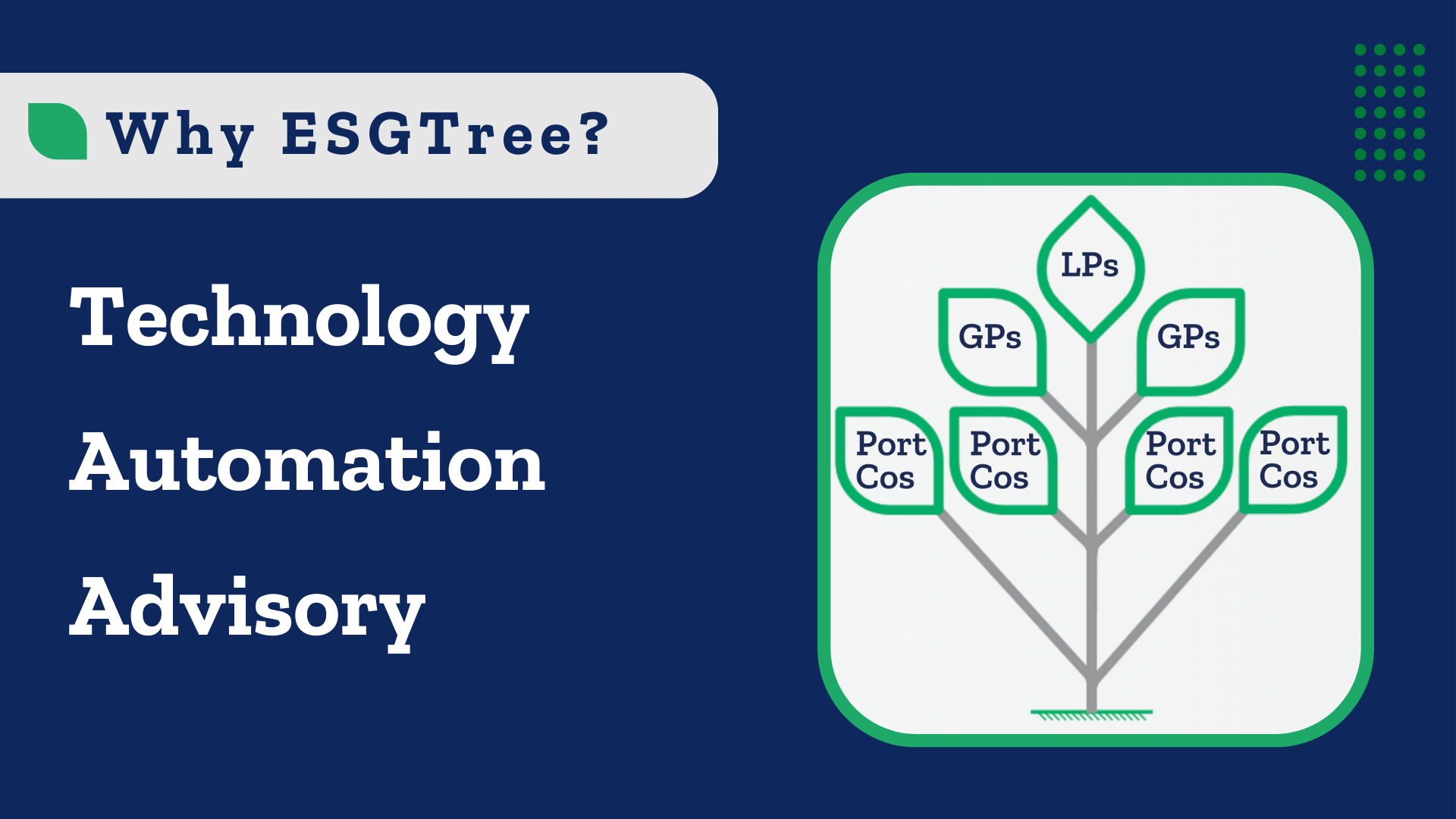
Our entire tech stack and back-end/front-end is purpose-built for the private investor use case e.g., our three-tier database structure allows seamless data aggregation and analytics upwards from portfolio companies to General Partners (GPs) to Limited Partners (LPs) in real-time without any customization required. This platform also provides access, as needed, to Environment, Social, and governance (ESG) teams, deal teams, and partners at the firm level to ensure alignment at all levels. This is just one example of our ‘built for purpose’ approach.

2. Seasoned ESG & Impact Founding Team:

Our Founding team collectively has over 20 years of experience working with over two dozen Private Equity (PE) firms on ESG/impact strategy and reporting prior to launching ESGTree. We are seasoned ESG professionals who decided to build technology for solutions we had been implementing for many years. Owing to our ESG and impact backgrounds, we are familiar with the developments and nuances of ESG’s evolution since the early 2000s.

3. Continuous engagement and innovation to meet industry needs:

As a company that was built organically with a product, customer, and revenue focus, we are already profitable and debt-free in our fourth year of operation. We are not under pressure to scale and sell assembly line / off-the-shelf products. We have the time and interest to customize our solutions in a way that they provide real solutions for real problems. ESG needs are slowly converging onto major standards, but firms still have unique needs driven by boards, management, LPs and compliance needs, which are particular to their business. We are not only okay with addressing these nuances but are passionate about them as they contribute towards the continuous growth and innovation of our platform.

ESGTree Features:

Our unique ESG scorecards, benchmarking tool, and carbon calculation software serve a diverse set of private equity firms. Thanks to the Platform Features below, we have been able to position ESG as a value-creation exercise rather than a reporting burden:

  • Automated data collection with portfolio-level access & aggregation capabilities
  • Company-specific ESG scorecards to provide value creation for portfolio companies
  • Simplified greenhouse gas emissions calculator
  • Multi-level trends analysis and visualizations by indicator, framework, and reporting periods
  • Client success support from ESG experts
  • Ready-to-implement framework automation including SASB, IRIS+, TCFD, EDCI, PCAF, SFDR and DEI.
  • Industry benchmarking against a dataset of 10,000+ companies
  • Purpose-built to streamline ESG reporting and collaboration for Limited Partners (LPs), General Partners (GPs) and portfolio companies.

Our Clients

We have helped a number of financial institutions automate their ESG and carbon emissions data monitoring through our cloud-based system. Today, our system analyzes data for over 2,000 corporations on their way to Net Zero.

Reach out to us today at [email protected] to accelerate your journey to net zero.

ESGTree streamlines our ESG reporting to our investors. Most notably, the Carbon Calculator feature, which reduces the time taken to calculate carbon emissions by 70%. Kudos to the ESGTree team for providing such a seamless user experience. Senior Market Analyst at Emburse

ESGTree is great at helping to bring management teams on the same page. We view the ESGTree system and team as more of an extension of our company rather than a Software provider.

Director, Investor Relationships at ICV Partners

ESGTree provides powerful data solutions to help private equity (PE) and venture capital (VC) firms gather, collect, analyze, benchmark and report their ESG data and that of their portfolio companies. Our carbon calculator, customizable and automated ESG frameworks, multi-level report viewing, trends analysis dashboard, and other features aimed to make ESG a value creation tool rather than a reporting burden.

Click here to learn more about our ESGTree’s ESG software solution for Private Equity & Venture Capital.

With ESGTree, save the time and cost of ESG reporting by harnessing the power of the cloud and streamlining ESG data collection, analysis and disclosure.  

For more information on the ESGTree’s ESG Reporting Solution, please contact us at :

[email protected]

or

Click here to book a demo.

Contact Us

Email

Office Addresses

Canada: ESGTree, CPA 4th Floor, 140 West mount Rd N, Waterloo,
ON N2L 3G6, Canada

United Kingdom: ESGTree, 33 Queen Street, London EC4R 1AP, United Kingdom